Quick answer
U.S. classification, duty, FCC certification, Network Protection Standard and carrier-consent rules for GSM cellular signal boosters.
Classification and duty conclusion
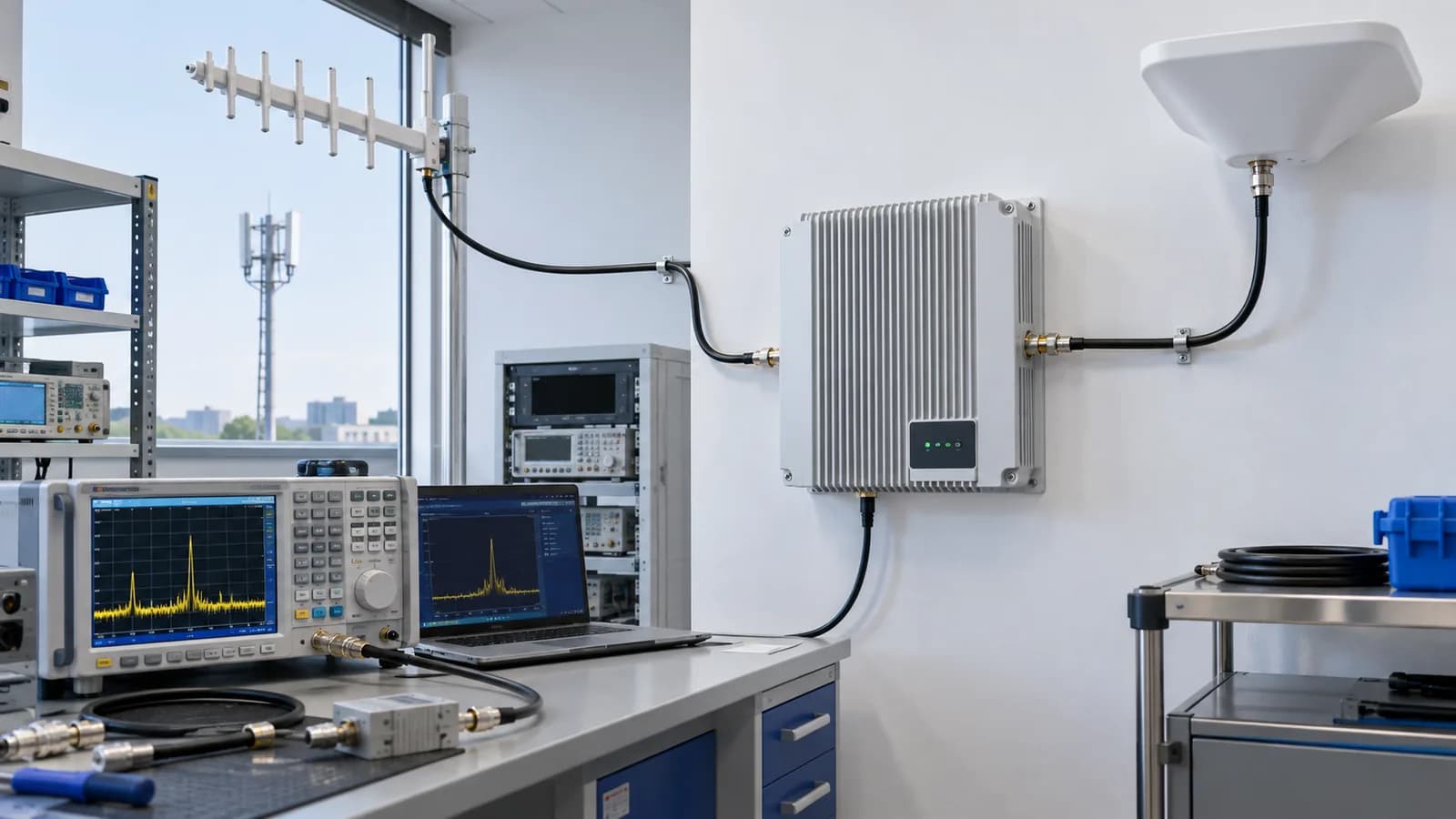
A complete bidirectional GSM repeater that receives, amplifies and retransmits cellular signals is ordinarily examined in HTSUS 8517.62.0090, the residual provision for machines that receive, convert and transmit or regenerate voice, images or other data. The 2026 Column 1 General rate is Free. CBP rulings under heading 8517.62 support classification of communication equipment performing reception and regeneration, but no ruling should be extended beyond its facts. The Vietnamese eight-digit code 85176259 has no legal effect in a U.S. entry.
Facts controlling the ten-digit HTSUS number
Record supported bands, uplink and downlink paths, output power, gain, bandwidth, automatic gain control, oscillation detection, antennas, network interface and whether the product is a complete repeater, a distributed-antenna component, a base station, a remote radio head or a separately imported RF amplifier. GRI 1 and 6 govern the objective condition at entry. A recurring or high-value model should be submitted for a binding ruling under 19 CFR Part 177 if its architecture leaves a material classification question.
FCC authorization before import and marketing
A cellular booster is an intentional radiator and must hold an FCC equipment authorization covering the exact model before importation or marketing, subject only to a specific lawful exemption. The application and test record must address the applicable service rules, RF exposure, labeling and the Network Protection Standard. FCC KDB Publication 935210 provides signal-booster certification guidance. A foreign CE, SRRC, KC or Vietnamese certificate does not replace an FCC grant, and changing amplifier hardware, firmware, antennas or frequency bands may require a permissive change or new authorization.
Operation requires more than customs clearance
For a consumer signal booster under 47 CFR § 20.21, the operator must obtain the serving carrier's consent, register the booster where the provider requires registration, use approved antennas and cables, operate only on authorized frequencies and shut the unit down if it causes harmful interference. Industrial signal boosters follow a different framework under § 20.21 or 47 CFR § 90.219, depending on the system and licensee. Customs release is therefore not permission to energize the equipment. The buyer, installer, carrier relationship and intended frequencies must be documented before shipment.
Origin, additional duties and entry file
The base duty may be free while other charges remain. Mark the actual country of origin in English under 19 CFR Part 134. For China-origin goods, review the current Chapter 99 and USTR Section 301 measures on the entry date; do not assume a free 8517.62 rate is the total landed duty. Keep the commercial invoice, valuation records, origin analysis and production flow, FCC grant and test reports, user manual, photographs, block diagram, band/power/gain table, antenna list, labels and carrier/installer records.
Suggested declaration and exclusions
A useful description is: “Bidirectional GSM 2G/2.5G cellular signal repeater, receives and retransmits uplink/downlink signals, bands ..., output ... dBm, gain ... dB, model ..., FCC ID ..., new; HTSUS reference 8517.62.0090.” Classify antennas, coaxial cable, splitters, combiners and power supplies separately when entered separately. Reassess a multiband or multitechnology unit, optical repeater, DAS head-end, base station or device with switching/routing functions not described in the assumed facts.
Official U.S. sources
Sources checked September 22, 2026: USITC 2026 HTS archive; CBP ruling H126020; CBP ruling N361336; 47 CFR 20.21; FCC KDB 935210; FCC equipment authorization; 19 CFR Part 134.
Official sources to verify
- WCO — HS Nomenclature 2022 and General Rules for Interpretation
- United States International Trade Commission — Harmonized Tariff Schedule
Editorial note
Prepared by the Global HS Code Checker Editorial Team for customs-classification, tariff and import-policy research. The correct code and applicable measures may change with the merchandise's actual characteristics, jurisdiction, entry date and supporting record. Verify the current tariff, governing measures and competent customs authority before filing an entry. A reviewer is identified only after a named expert has completed the review.