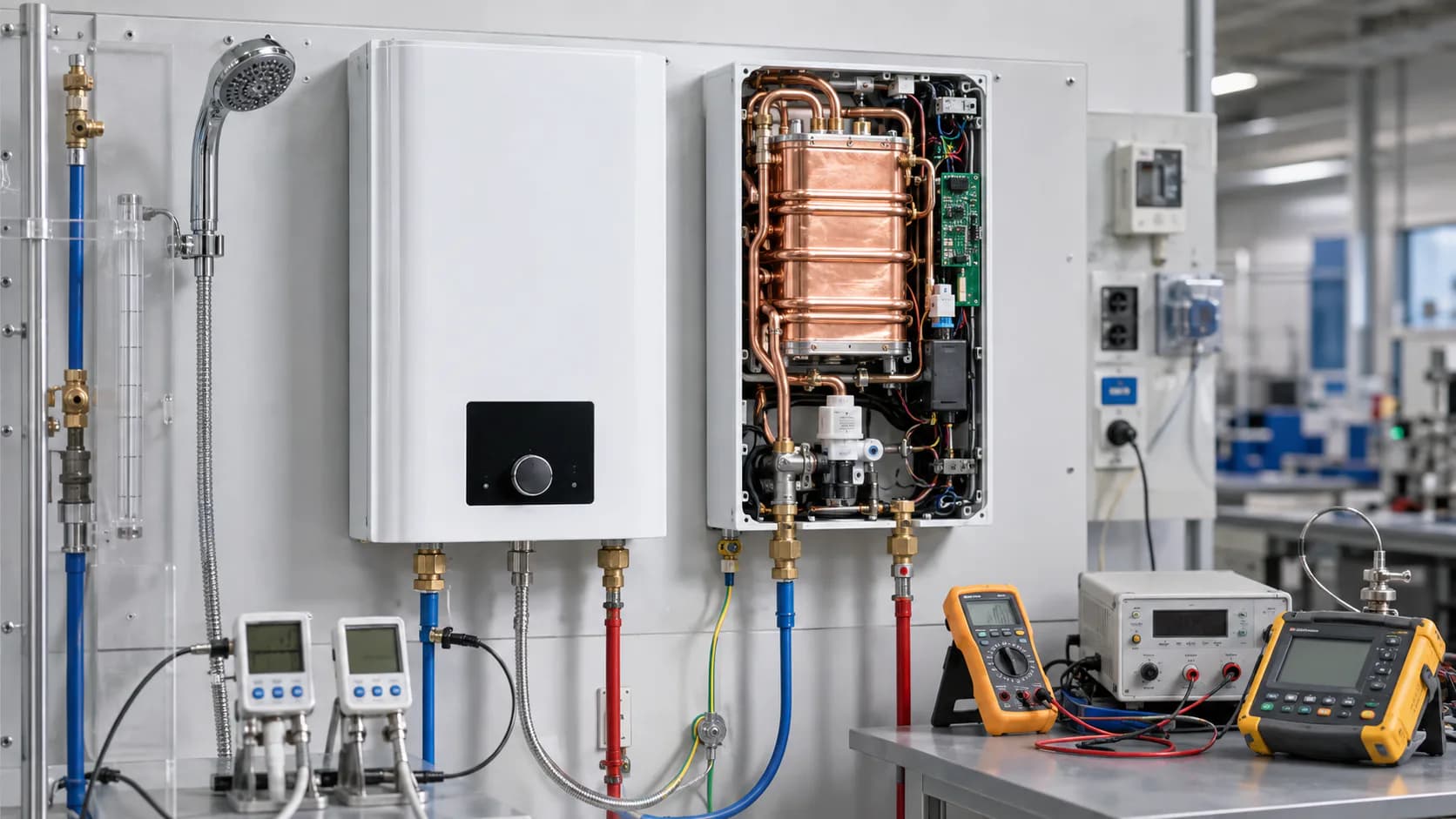
Classification conclusion
Household tankless electric water heaters generally enter under 8516.10.0080. Review duty, Section 301, DOE efficiency, EnergyGuide and electrical requirements.
| Field | Conclusion |
|---|---|
| Proposed HTS code | 8516100080 — Other electric water heaters and immersion heaters |
| Jurisdiction | United States |
| Tariff edition | HTSUS 2026 |
| Rules applied | GIR/GRI 1 and 6 |
| Confidence | High when the entered merchandise matches the stated facts |
| Condition | A new household electric instantaneous water heater that heats flowing water directly below boiling temperature and has no hot-water storage tank. |
U.S. HTSUS classification and duty at a glance
This guide covers a new household electric instantaneous water heater that heats flowing water directly, has no hot-water storage tank, and delivers water below boiling temperature.
| Product | HTSUS reporting number | Column 1 General | Column 2 |
|---|---|---|---|
| Instantaneous electric water heater, other than storage type | 8516.10.0080 | Free | 35% |
Vietnam's 8516.10.19 is not a valid ten-digit U.S. reporting number. Under the HTSUS, heading 8516 covers electric instantaneous or storage water heaters and immersion heaters; the non-storage product is reported in 8516.10.0080.
Classification under the GRIs
GRI 1 places an electric appliance whose principal function is heating flowing water in heading 8516. GRI 6 selects subheading 8516.10, and the U.S. statistical breakout distinguishes storage water heaters from other water heaters and immersion heaters.
The file should establish direct-flow operation, absence of a storage tank, rated voltage, phase, wattage, maximum flow, pressure, temperature range and intended household use. CBP rulings under 8516.10.0080 are useful evidence of the U.S. statistical structure, but a ruling involving a different heater is not binding for this product.
Products outside the stated conclusion
- Storage-tank electric water heaters use the dedicated storage reporting provisions.
- Immersion elements imported separately may remain within 8516.10.0080 but require their own description and entry analysis.
- Electric kettles, beverage makers and boiling-water appliances may fall elsewhere in heading 8516.
- Gas-fired or other nonelectric instantaneous water heaters are generally analyzed in heading 8419.
- Combination boilers, heat pumps, commercial process equipment and separately imported control modules require separate classification.
Duties for China-origin merchandise
For a China-origin product entered under 8516.10.0080:
- Column 1 General duty is Free.
- The legacy Section 301 action currently adds 7.5% under 9903.88.15 for covered 8516.10.00 merchandise.
- The reviewed 2026 forced-labor Section 301 action adds 12.5% under 9903.05.31 because the tariff line was not identified in the applicable product-exception list.
- The former IEEPA reciprocal-duty program ended on February 20, 2026 and should not be added as a current duty line.
- No Section 232 or Section 201 measure was identified for the finished heater.
- No AD/CVD order specifically covering generic finished instantaneous electric water heaters was identified in the reviewed sources. Scope, origin, producer and exporter must nevertheless be checked before entry.
Accordingly, a covered China-origin unit may face 20% additional Section 301 duty in aggregate, before fees, even though the base rate is Free. Formal entries are generally subject to the Merchandise Processing Fee at 0.3464%, within the statutory minimum and maximum; commercial vessel cargo may also incur the 0.125% Harbor Maintenance Fee.
DOE, FTC and electrical compliance
A household instantaneous electric water heater may be a covered consumer product under the Energy Policy and Conservation Act and 10 CFR parts 429 and 430. Confirm whether the model falls within DOE's consumer-water-heater definitions, including the applicable power and capacity limits, and complete the prescribed test procedure, certification and recordkeeping before distribution.
The FTC Energy Labeling Rule in 16 CFR part 305 includes an EnergyGuide template for instantaneous water heaters. The manufacturer/importer should confirm the current labeling, placement and efficiency-disclosure requirements for the exact model.
Electrical safety is a separate layer. Product listing by an OSHA-recognized NRTL to the applicable electrical standard is commonly required by employers, installers, retailers or state/local electrical and plumbing codes. It is not a substitute for HTS classification or DOE/FTC compliance. Also review:
- Permanent rating plate, installation instructions, grounding, over-temperature protection, dry-fire protection, pressure rating, leakage protection and branch-circuit requirements.
- State plumbing and potable-water-contact requirements for wetted materials.
- FCC Part 15 authorization if the unit contains intentional or unintentional radio-frequency functions.
- California Proposition 65 and other state disclosures where applicable.
- Country-of-origin marking under 19 U.S.C. 1304 and 19 CFR part 134.
Entry documentation checklist
- Datasheet and drawings showing tankless direct-flow operation, heat exchanger/heating element and control system.
- Rated voltage, phase, amperage, kW, flow, pressure and maximum outlet temperature.
- Model-specific DOE test/certification file and FTC EnergyGuide analysis, when covered.
- Electrical safety reports/listing, wetted-material evidence and state-specific compliance records.
- Origin analysis, Section 301 Chapter 99 lines, invoice, packing list and country marking.
- Producer/exporter AD/CVD scope search completed close to entry.
Suggested commercial description
Household instantaneous electric water heater, tankless direct-flow type, rated ... V, ... phase, ... kW, maximum flow ... L/min, outlet temperature below boiling, model ..., country of origin ..., HTSUS 8516.10.0080.
Replace every ellipsis with actual product data. Do not describe a storage heater, kettle or separate heating element as a complete instantaneous heater.
Official sources
- USITC current Harmonized Tariff Schedule
- U.S. Department of Energy consumer water heaters
- FTC EnergyGuide labels and templates
- OSHA Nationally Recognized Testing Laboratory program
- USTR Section 301 investigations
- ITA ACCESS AD/CVD search
Conclusion
A new household tankless electric water heater that directly heats flowing water is generally entered under HTSUS 8516.10.0080, with a Free Column 1 General rate and 35% Column 2 rate. China-origin merchandise currently requires separate review of the 7.5% legacy and 12.5% 2026 Section 301 lines. Classification does not replace DOE efficiency certification, FTC EnergyGuide, electrical safety, state-code, marking or trade-remedy compliance.
This publication is general information, not a binding CBP ruling or legal opinion. Final treatment depends on construction, storage capacity, power, intended use, origin, producer and entry date.
Law and tariff reviewed through September 4, 2026.
2026 U.S. customs and import-law review
Legal review date: September 5, 2026. The USITC online HTSUS identified 2026 Revision 18 on this review date. Rates and Chapter 99 measures can change during the year, so the legally operative schedule is the edition in effect on the entry date.
1. Quick legal conclusion
The proposed reporting number is 8516100080 for Other electric water heaters and immersion heaters, but only for merchandise that matches this defined scope: A new household electric instantaneous water heater that heats flowing water directly below boiling temperature and has no hot-water storage tank. This is a fact-dependent classification opinion, not a CBP ruling and not a determination of admissibility, origin or AD/CVD scope.
2. Facts that must be verified before entry
- Tank capacity or confirmed absence of a tank
- Voltage, phase, kW, flow, pressure and outlet temperature
- Origin, model, factory, test reports and certification
Also obtain the complete bill of materials, technical drawings, model numbers, operating manual, condition and configuration as imported, transaction chain, manufacturer/producer, country of origin of material inputs and intended U.S. use. A material difference requires a new analysis.
3. HTSUS analysis and controlling authority
- GRI 1 places electric instantaneous water heaters in heading 8516; GRI 6 selects the U.S. non-storage reporting number 8516.10.0080.
- Tankless direct-flow operation distinguishes the product from storage heaters, kettles, dispensers and nonelectric water heaters.
The analysis must begin with GRI 1, the heading text and binding Section/Chapter Notes, then proceed to GRI 2–5 only if legally necessary and to GRI 6 for subheadings. U.S. Additional Rules of Interpretation and Additional U.S. Notes are controlling where applicable. WCO Explanatory Notes are persuasive interpretive material but are not U.S. statutory text. A CROSS ruling is binding only for the requester and merchandise covered by its facts; materially similar rulings may be persuasive. CIT and Federal Circuit decisions control within their jurisdiction.
Goods outside this opinion include:
- Storage heaters, kettles, gas heaters, industrial systems and separately imported elements or controls require separate classification.
For recurring or high-value entries, request a prospective binding ruling from CBP under 19 CFR Part 177 and disclose all material facts. A ruling request is not a substitute for checking post-ruling HTSUS amendments or trade remedies.
4. Duty, fee and tax matrix
| Charge | Legal treatment for this article |
|---|---|
| HTSUS Column 1 General duty | Apply the rate printed beside 8516100080 in the HTSUS edition effective on the entry date. Any rate stated elsewhere in the article remains provisional until that check is completed. |
| Merchandise Processing Fee (MPF) | Formal entries generally incur 0.3464% of entered value, excluding duty, freight and insurance, subject for FY 2026 to the CBP minimum $33.58 and maximum $651.50; an applicable preference program can alter MPF treatment. |
| Harbor Maintenance Fee (HMF) | 0.125% of value when commercial cargo is unloaded from a vessel at a covered U.S. port; it ordinarily does not apply to air freight. See 26 U.S.C. 4461–4462 and 19 CFR 24.24. |
| Section 301 / other Chapter 99 duty | Determine from the exact 8-digit HTSUS provision, country of origin, effective date and any valid exclusion. Report the required Chapter 99 number; do not assume the base HTS rate is the total landed duty. |
| Section 232 | Check current Chapter 99 notes, product/derivative coverage, origin and any required steel/aluminum/copper content, melt-and-pour or smelt-and-cast data. It does not apply merely because the article contains some metal. |
| AD duty | Not determinable from an HTS number. The written scope of an AD order is dispositive; HTS references are for convenience. Review product, producer/exporter, origin and circumvention findings. Cash-deposit and final assessment rates can differ. |
| CVD duty | The same written-scope rule applies. Confirm the case-specific company or all-others cash-deposit rate and liquidation instructions in Commerce ACCESS and ACE. |
| Safeguard / quota | Check current Chapter 99, quota and safeguard measures as of entry. Product scope, origin, quantity and quota period control. |
| Federal excise tax | No product-specific federal excise tax is identified from the stated facts; confirm the intended use and the current Internal Revenue Code before entry. |
| State sales/use and other state taxes | These are not CBP customs duties. They depend on destination, importer nexus, later sale/use and state/local law and require a separate domestic-tax review. |
This table does not calculate landed cost. The importer must also determine customs value under 19 U.S.C. 1401a, including assists, packing, royalties/license fees, proceeds and related-party acceptability. A “first sale” claim requires a bona fide sale for export to the United States, arm's-length evidence and a complete transaction trail.
5. AD/CVD and evasion review
Do not infer trade-remedy status from the HTS number alone. Screen the country of origin, producer and written scope of every active AD/CVD order, and test any applicable Chapter 99 provision as of the entry date.
The written scope description is dispositive; an HTSUS number in an order is only a convenience reference. If coverage is uncertain, obtain a Commerce scope ruling under 19 CFR 351.225 before relying on a non-covered position. Minor processing or assembly in a third country can trigger a circumvention analysis. False origin, undervaluation or evasion can lead to EAPA investigation under 19 U.S.C. 1517 and civil penalties under 19 U.S.C. 1592.
6. Partner Government Agency and product compliance
Determine coverage under DOE energy-conservation, testing and certification rules in 10 CFR Parts 429 and 430 and any FTC Energy Labeling Rule requirement in 16 CFR Part 305. Electrical, plumbing, building and efficiency rules of the destination state or locality remain separate.
PGA admissibility is independent of tariff classification. Transmit all required agency data and documents through ACE; a CBP release does not cure a violation of an FDA, CPSC, EPA, FCC, DOT, USDA or other agency rule.
7. Origin, marking and UFLPA
Determine nonpreferential origin under the substantial-transformation test and any product-specific rule; do not rely only on the shipping country, invoice origin or location of final packing. Mark the article and, when required, its container under 19 U.S.C. 1304 and 19 CFR Part 134, unless a documented exception applies. Section 301, AD/CVD, government procurement and a preference program may use distinct origin rules.
Under 19 U.S.C. 1307 and the UFLPA, goods mined, produced or manufactured wholly or in part in Xinjiang, or by an entity on the UFLPA Entity List, are subject to a rebuttable presumption of exclusion. Maintain supplier identity, production, payment, logistics and input-tracing evidence; a generic supplier declaration is not enough for a high-risk supply chain.
8. Minimum entry file
- CBP entry/cargo release data and Form 7501 record, customs bond, commercial invoice, packing list and bill of lading/air waybill.
- Purchase orders, payment records, Incoterms, assists/royalties analysis and related-party or first-sale valuation support.
- Product specifications, drawings, photographs, manuals, composition/BOM, model cross-reference and condition as imported.
- Signed classification memorandum applying the GRIs, legal notes, current HTSUS text and relevant rulings, plus rejected alternatives.
- Origin and marking analysis; producer/supplier affidavits and traceability records; Chapter 99 and exclusion support.
- AD/CVD scope search, producer/exporter case numbers and cash-deposit instructions, even when the conclusion is “not covered.”
- All PGA registrations, certificates, laboratory reports, licenses, notices and ACE data required for this product.
Keep entry and supporting records for the statutory period, generally five years, under 19 U.S.C. 1508 and 19 CFR Part 163.
9. Principal legal risks
- Declaring a 10-digit number from the trade name without proving the imported condition and legally relevant characteristics.
- Omitting a Chapter 99 number or calculating only the Column 1 rate.
- Treating an AD/CVD HTS cross-reference as dispositive instead of reading the written scope.
- Using shipping country as origin without a substantial-transformation and marking analysis.
- Filing before PGA admissibility, certificates, laboratory evidence or supply-chain traceability are complete.
An incorrect entry can produce redelivery, exclusion/seizure, duty reassessment, interest, loss of liquidation defenses and penalties. If past entries contain a material error, promptly evaluate a post-summary correction, protest, prior disclosure under 19 CFR 162.74 or other corrective procedure with U.S. customs counsel; the correct route depends on entry and liquidation status.
10. Pre-entry action checklist
1. Lock the specifications and imported configuration for the exact SKU. 2. Re-run classification against the current HTSUS and record GRI/Note reasoning. 3. Determine customs value, nonpreferential origin and marking. 4. Screen Chapter 99, Section 301/232, quota/safeguard and every potentially relevant AD/CVD scope. 5. Complete the product-specific PGA review and obtain supporting certificates before shipment. 6. Calculate landed duties and fees, then have the importer and licensed customs broker validate ACE reporting. 7. For unresolved or commercially material classification issues, obtain a CBP Part 177 ruling before importation.
Official legal sources
- United States International Trade Commission; HTSUS 2026: Harmonized Tariff Schedule of the United States
- U.S. Department of Energy; 10 CFR Parts 429 and 430: Consumer water heaters
- Federal Trade Commission; 16 CFR Part 305: EnergyGuide labels and templates
- USITC — Current Harmonized Tariff Schedule of the United States
- CBP — User fee table: MPF rate and FY 2026 minimum/maximum
- CBP — Harbor Maintenance Fee
- CBP — ACE: filing customs and Partner Government Agency data
- USTR — Section 301 tariff actions and exclusion search
- BIS — Section 232 steel and aluminum measures
- Commerce — AD/CVD FAQs, scope and circumvention rules
- Commerce — ACCESS AD/CVD proceeding search
- CBP — UFLPA rebuttable presumption
- CPSC — Certificates and mandatory eFiling guidance
- FDA — Importing food products into the United States
- EPA — TSCA requirements for importing chemicals
- PHMSA — Lithium battery transportation requirements
- FCC — Equipment authorization
- eCFR — 19 CFR Part 177: administrative rulings
- eCFR — 19 CFR Part 134: country-of-origin marking
- eCFR — 19 CFR Part 163: recordkeeping
> Legal notice: This article provides general U.S. customs and trade-compliance information based on the stated facts as of September 5, 2026. It is not a CBP, Commerce or PGA ruling and is not legal advice for a specific transaction. Current HTSUS/Chapter 99 text, agency requirements and case-specific AD/CVD instructions must be rechecked at entry.
Editorial note
Prepared by the Global HS Code Checker Editorial Team for customs-classification, tariff and import-policy research. The correct code and applicable measures may change with the merchandise's actual characteristics, jurisdiction, entry date and supporting record. Verify the current tariff, governing measures and competent customs authority before filing an entry. A reviewer is identified only after a named expert has completed the review.