Quick answer
Distinguish a load-carrying AGV without handling equipment from an AGV with lift or transfer hardware; review duty, Chapter 99, origin and OSHA records.
U.S. classification and import answer
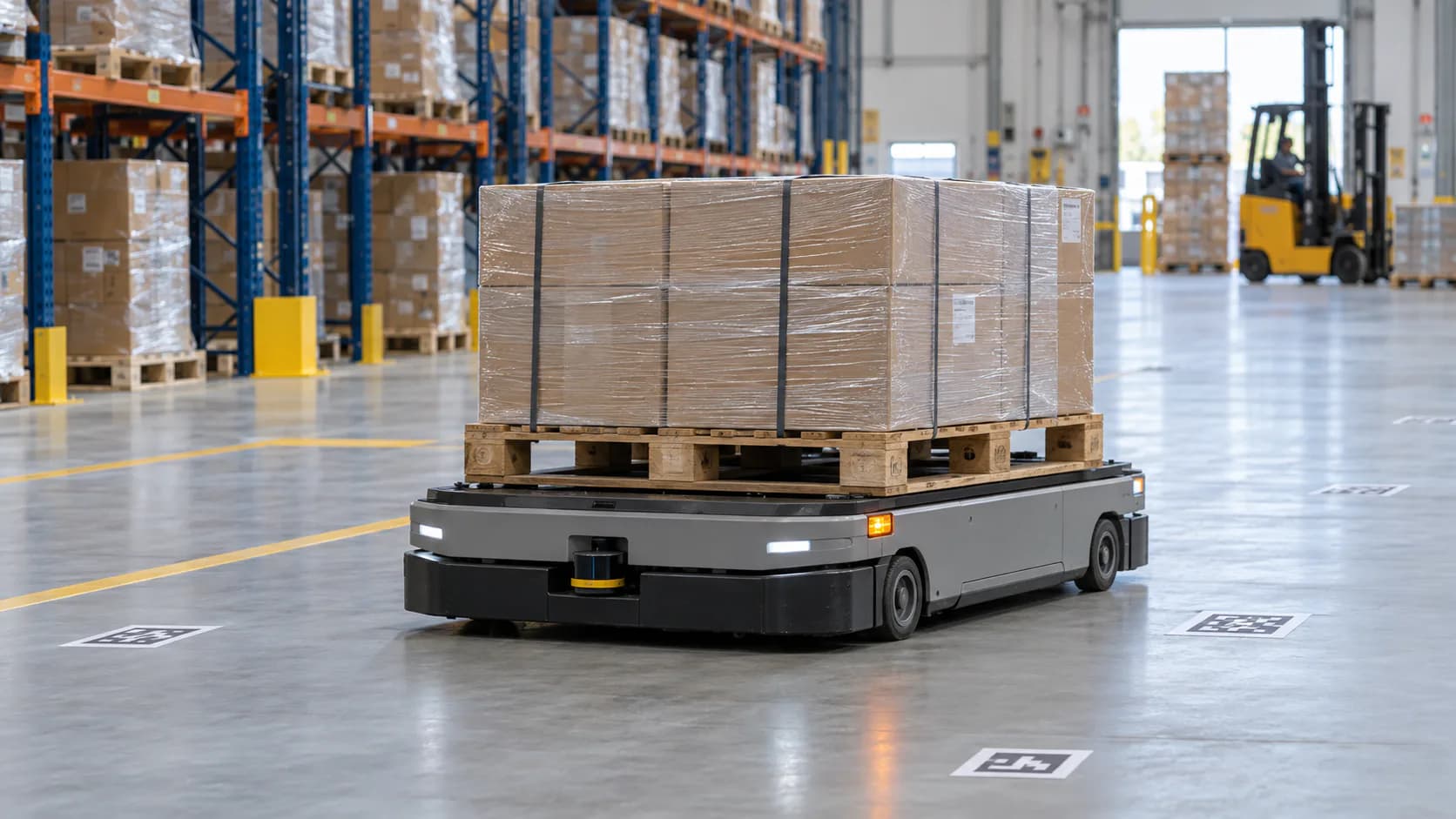
AGV is not a single tariff classification. An electric self-propelled works truck used for short-distance goods transport in a factory or warehouse, with a fixed load platform and no lifting or handling equipment, is supported in HTSUS 8709.11.00. An AGV with an integral fork, lift table, clamp or active transfer device is compared with 8427.10.8050, whose text expressly includes automated guided vehicles. A conveyor system or AS/RS may require heading 8428 analysis. The conclusion remains conditional until the as-entered configuration, origin and entry date are documented.
Facts that control AGV classification
Record propulsion, battery, operator mode, payload, speed, turning radius, public-road capability, load deck, tow hitch, lift stroke, forks, rollers, conveyor, clamp, sensors, navigation method and software function. Also identify whether one vehicle, an unassembled vehicle, parts, or a coordinated system is entered. Apply GRIs 1 and 6 and the legal notes before resorting to trade names. Magnetic tape, QR, lidar or SLAM navigation changes control technology; it does not by itself move a goods works truck to the residual robot provision.
No lifting or handling equipment: 8709.11.00
Heading 8709 covers self-propelled works trucks not fitted with lifting or handling equipment, of the type used in factories, warehouses, docks or airports for short-distance goods transport. CBP HQ 960303 applied 8709.11.00 to electric utility works trucks after examining platform, speed, turning radius and limited operating environment. A driverless flat-deck AGV can fit the same six-digit concept when its objective design is goods transport and its deck does not lift, push or transfer the load. Keep engineering evidence that distinguishes it from a road vehicle.
Lift or handling equipment: 8427.10.8050
Heading 8427 covers fork-lift and other works trucks fitted with lifting or handling equipment. In N353392, September 18, 2025, CBP classified a battery pallet shuttle with sensors, a 1,500 kg payload and only 43 mm lift stroke in 8427.10.8050, an electric AGV provision. Thus even a short lift or active load-transfer mechanism can defeat heading 8709. Confirm whether powered rollers merely support or actually receive/discharge goods; the complete mechanical function, not the supplier label, controls.
AMRs and integrated systems
An autonomous mobile robot mainly inspecting, cleaning or performing a special service rather than carrying goods as a works truck may require 8479.89 or a more specific functional heading. Machines imported together and interconnected to perform a clearly defined automated storage, retrieval or conveying function may be analyzed as a Section XVI Note 4 functional unit under heading 8428. One purchase order and common software do not automatically absorb static racks, building structures or independently functioning machinery into one tariff line.
Parts, batteries, chargers and controls
Parts solely or principally used with heading 8709 vehicles may fall in 8709.90; qualifying 8427 parts may fall in 8431.20 under Section XVI Note 2. Batteries, chargers, motors, computers, radio devices, sensors and control panels described in their own headings remain there when entered separately. Identify assists, engineering, software, royalties and separately purchased components for customs valuation. A lithium battery also needs transport classification, UN 38.3 evidence and carrier-compliant packaging.
Base duty and Chapter 99
The current HTSUS Column 1 General rate for 8709.11.00 and 8427.10.8050 is Free, but that does not establish zero landed duty. For China-origin 8709.11.00 goods, U.S. note 20 may impose Section 301 duties; Chapter 99 treatment for 8427 equipment, derivative steel or aluminum content, temporary exclusions and any emergency measure must be checked in the live HTS on the entry date. MPF applies, and HMF may apply to ocean entries. AD/CVD scope is controlled by order language, not the tariff number alone.
PGA, origin and import controls
No general federal import licence was confirmed merely because an article is an AGV. Still screen FCC radio authorization, NHTSA only if road-vehicle facts exist, hazardous-material transport for batteries, sanctions, export-control end use and any applicable PGA. Mark actual country of origin under 19 U.S.C. 1304 and 19 CFR Part 134. Assembly location is not automatically origin; retain component sources and substantial-transformation analysis. UFLPA and 19 U.S.C. 1307 require traceability where the supply chain presents forced-labor risk.
OSHA and operational safety
Import release does not authorize unsafe operation. OSHA 29 CFR 1910.212 requires guarding against machine hazards, and 1910.147 addresses hazardous-energy control during servicing. Validate personnel detection, stopping distance, crossing speed, restart prevention, emergency stop, load retention, charging and fire response, and interfaces with pedestrians and forklifts. ANSI/ITSDF B56.5 and ISO 3691-4 are useful consensus references, but they do not replace the employer's fact-specific OSHA duties.
Entry record and proposed description
Keep the contract, invoice, packing list, bill of lading, photos, video, drawings, BOM by crate, payload, lift stroke, deck and transfer details, battery chemistry, radio module, software function, origin production record and valuation file. A proposed 8709 description is: “Electric self-propelled automated guided works truck for short-distance warehouse transport of goods, fixed load deck, not fitted with lifting or handling equipment, payload ... kg, model ..., new, origin ...”. If the vehicle has lift or active transfer hardware, describe it affirmatively and do not use that wording.
Official authorities, limits and ruling strategy
Official sources checked September 12, 2026: current HTSUS, CBP N353392, CBP HQ 960303, CBP CROSS, OSHA 29 CFR 1910.212 and USTR Section 301. This is conditional guidance, not a binding ruling. For a recurring or high-value program, seek a prospective CBP ruling with the complete as-entered sample and separate questions for 8709, 8427 and system components.
Official sources to verify
- WCO — HS Nomenclature 2022 and General Rules for Interpretation
- United States International Trade Commission — Harmonized Tariff Schedule
Editorial note
Prepared by the Global HS Code Checker Editorial Team for customs-classification, tariff and import-policy research. The correct code and applicable measures may change with the merchandise's actual characteristics, jurisdiction, entry date and supporting record. Verify the current tariff, governing measures and competent customs authority before filing an entry. A reviewer is identified only after a named expert has completed the review.