Classification conclusion
U.S. tariff classification, CBP rulings, duty, OSHA and lithium-battery compliance for a rider-type counterbalanced electric forklift.
| Field | Conclusion |
|---|---|
| Proposed HTS code | 8427104000 — Rider-type counterbalanced fork-lift trucks |
| Jurisdiction | United States |
| Tariff edition | HTSUS 2026 |
| Rules applied | GIR/GRI 1 and 6 |
| Confidence | High when the entered merchandise matches the stated facts |
| Condition | A complete rider-operated, counterbalanced electric forklift with an overhead guard, mast and forks, imported new for pallet handling. |
What is the HTSUS code for an electric forklift?
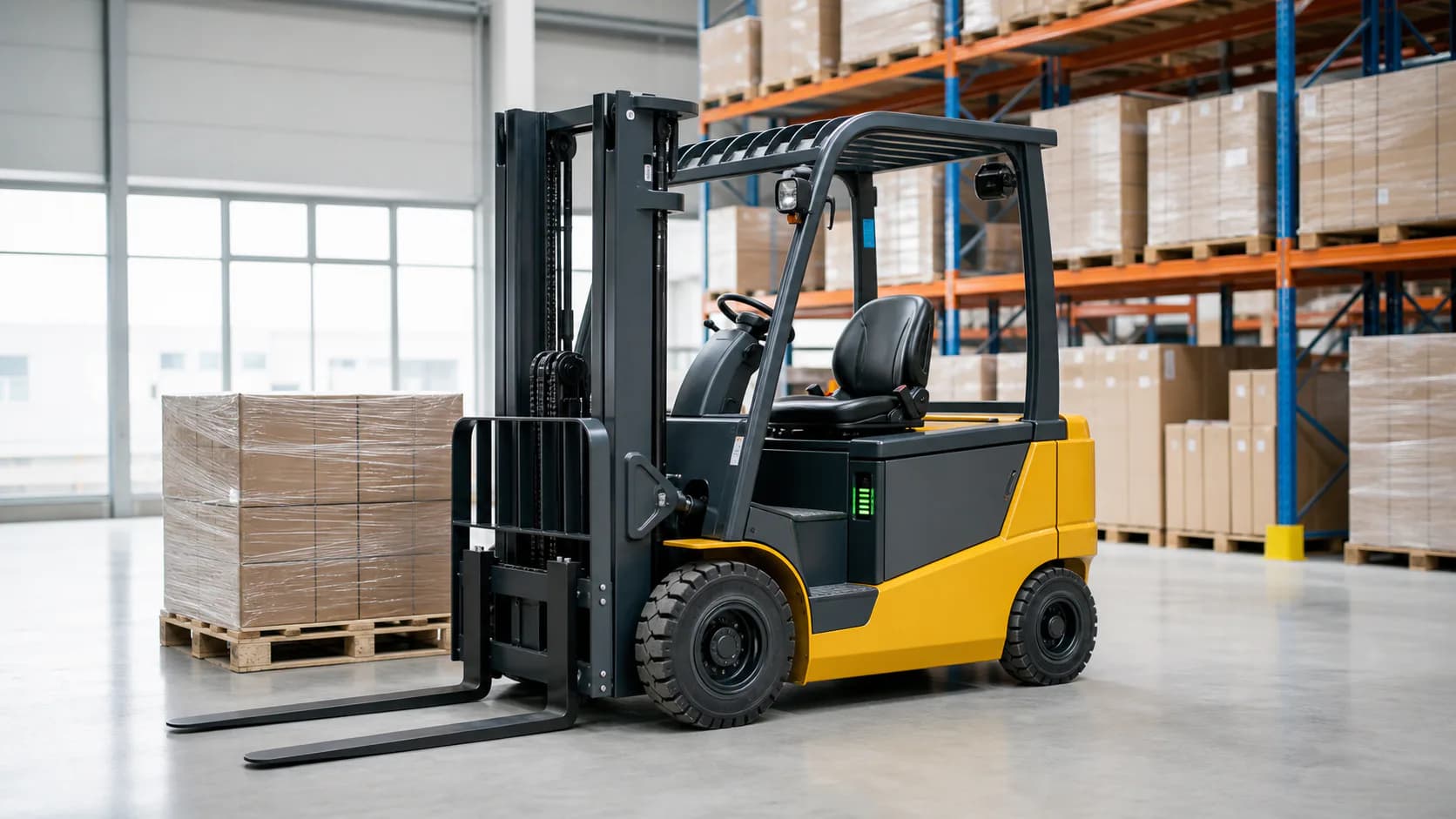
For a complete rider-operated, counterbalanced electric forklift with an overhead guard, mast and forks, designed to lift and stack palletized goods, the appropriate U.S. classification is generally HTSUS 8427.10.4000.
| Issue | U.S. customs conclusion |
|---|---|
| Product | Rider-type counterbalanced electric forklift |
| HTSUS number | 8427.10.4000 |
| General duty rate | Free |
| General CBP import license | Not ordinarily required |
| China-origin additional duties | Current Chapter 99 treatment must be verified on the entry date |
| Workplace use | OSHA 29 C.F.R. § 1910.178 applies to powered industrial trucks |
| Lithium-battery transport | Review PHMSA classification and shipping requirements |
| Confidence | High only when the entered configuration matches the stated facts |
This conclusion does not automatically cover a walkie pallet truck, walkie stacker, narrow-aisle reach truck, order picker, autonomous guided vehicle, container handler, forklift attachment, battery or charger imported separately.
Why HTSUS 8427.10.4000 applies
GRI 1 directs classification according to the terms of the headings and relevant legal notes. Heading 8427 covers fork-lift trucks and other works trucks fitted with lifting or handling equipment.
GRI 6 then applies the subheading text. Subheading 8427.10 covers self-propelled trucks powered by an electric motor. Within the U.S. tariff, 8427.10.4000 covers rider-type counterbalanced fork-lift trucks. The imported machine must therefore show the objective features of that named class: an onboard operator position, counterweight, mast, load carriage and forks, with electric propulsion.
Battery chemistry, rated lifting capacity and mast height are important entry data, but they do not by themselves displace a complete rider-type counterbalanced electric forklift from this provision. Conversely, the marketing term “electric forklift” cannot override a materially different configuration.
CBP rulings that define the boundary
In NY N329057 (November 17, 2022), CBP classified an electric forklift from China in 8427.10.4000 and required the applicable Chapter 99 reporting then in force. NY H83985 also classified rider-type electric forklifts in 8427.10.4000.
The contrast matters. In NY N243059, an automated aisle/row shuttle was classified in a different statistical provision under 8427.10 because it was not the same rider-type counterbalanced forklift described here. Published rulings are persuasive evidence of CBP's interpretation, but they bind only the requesting party and the merchandise described. A new model with unusual steering, autonomy or lifting architecture may justify a binding-ruling request.
Configurations that require a fresh classification analysis
| Configuration as entered | Issue to resolve |
|---|---|
| Rider-type counterbalanced electric forklift | 8427.10.4000 when the stated features are present |
| Walkie pallet truck or pedestrian stacker | Review the applicable non-rider statistical breakout |
| Narrow-aisle reach truck or order picker | Do not assume the counterbalanced provision applies |
| Autonomous guided vehicle or shuttle | Analyze automation, lifting equipment and the precise 8427.10 breakout |
| Internal-combustion forklift | Review 8427.20 rather than 8427.10 |
| Battery or charger entered separately | Classify separately under the applicable electrical provision |
| Forks, mast or attachments entered separately | Review the parts provisions, including heading 8431 |
The invoice description should identify the operator type, counterbalanced construction, propulsion, rated capacity and lifting system. A bare statement such as “warehouse equipment” is not adequate tariff evidence.
Duty rate and China-origin trade remedies
The general duty rate for 8427.10.4000 is Free. Importers should confirm the live tariff text in the USITC HTS for the entry date.
A free general rate does not necessarily mean a duty-free entry. CBP ruling N329057 reported an additional China-origin Chapter 99 measure for the merchandise considered in 2022. Section 301 measures, exclusions and Chapter 99 reporting can change. The importer must therefore check the current USTR tariff actions, the current HTS Chapter 99 notes, country of origin and entry date rather than copying the Chapter 99 number from an older ruling.
Country of shipment is not necessarily country of origin. For forklifts assembled from multi-country frames, masts, controllers, traction motors and batteries, origin requires a substantial-transformation analysis supported by the manufacturing record.
U.S. import and workplace compliance
There is no general CBP import license solely because the article is a new electric forklift. Several separate regimes remain important:
- OSHA powered-industrial-truck rules: 29 C.F.R. § 1910.178 governs design and construction, markings, modifications, charging, maintenance, hazardous-location designations and operator training in the workplace. New trucks used by an employer must satisfy the incorporated design requirements, and approved trucks bear the appropriate testing-laboratory identification.
- Hazardous locations: E, ES, EE and EX designations are not interchangeable. A conventional warehouse forklift should not be represented as suitable for an explosive atmosphere without the required approval and marking.
- Lithium batteries: PHMSA guidance treats a battery-powered vehicle under the applicable dangerous-goods framework. A removed battery packed separately may instead be shipped as UN 3481. The shipping configuration, battery test record and watt-hour data must be confirmed before transport.
- Country-of-origin marking: 19 U.S.C. § 1304 and 19 C.F.R. Part 134 generally require the forklift or its container to be marked with the country of origin unless an exception applies.
- UFLPA: Importers should retain supply-chain evidence for steel, electronics and battery materials, especially where China-origin production creates forced-labor risk.
- Radio equipment: Telematics, cellular, Wi-Fi or remote-control modules may trigger FCC equipment-authorization requirements even though the forklift classification remains in heading 8427.
OSHA workplace compliance is not a CBP tariff condition, and tariff classification does not prove that a truck is approved for a particular workplace. The two analyses should be documented separately.
Documents to retain before entry
1. Product brochure showing rider operation, counterweight, overhead guard, mast and forks. 2. Rated capacity, load center, lift height, truck weight and turning radius. 3. Traction and lift-motor specifications, system voltage and battery chemistry. 4. Photographs of the machine and all capacity, safety and origin plates. 5. Battery UN 38.3 test summary and transport configuration where lithium batteries are used. 6. OSHA/NRTL listing or approval records applicable to the intended workplace. 7. Bill of materials and manufacturing flow supporting country of origin. 8. Invoice and packing list confirming whether the battery, charger and attachments are installed or separately entered.
Suggested entry description: “New rider-type counterbalanced electric forklift, model ..., rated capacity ... kg, mast lift height ... mm, ... V battery-powered, fitted with forks, for warehouse pallet handling.”
Primary authorities
- U.S. International Trade Commission — Harmonized Tariff Schedule of the United States
- U.S. Customs and Border Protection — NY N329057, electric forklift classified in 8427.10.4000
- U.S. Customs and Border Protection — NY H83985, rider-type forklifts
- U.S. Customs and Border Protection — NY N243059, automated shuttle distinguished from a rider forklift
- Occupational Safety and Health Administration — 29 C.F.R. § 1910.178, Powered Industrial Trucks
- Pipeline and Hazardous Materials Safety Administration — Lithium Battery Guide
Professional conclusion
HTSUS 8427.10.4000 is well supported when the imported article is a complete rider-type counterbalanced forklift propelled by an electric motor. It should not be used as a universal code for every electrically powered warehouse truck.
The three facts most likely to alter the result are the operator mode, counterbalanced versus narrow-aisle or pedestrian construction, and autonomous versus rider-controlled operation. Lock those facts first; then confirm current Chapter 99 treatment, origin, battery transport and OSHA workplace requirements.
2026 U.S. customs and import-law review
Legal review date: September 5, 2026. The USITC online HTSUS identified 2026 Revision 18 on this review date. Rates and Chapter 99 measures can change during the year, so the legally operative schedule is the edition in effect on the entry date.
1. Quick legal conclusion
The proposed reporting number is 8427104000 for Rider-type counterbalanced fork-lift trucks, but only for merchandise that matches this defined scope: A complete rider-operated, counterbalanced electric forklift with an overhead guard, mast and forks, imported new for pallet handling. This is a fact-dependent classification opinion, not a CBP ruling and not a determination of admissibility, origin or AD/CVD scope.
2. Facts that must be verified before entry
- Rider-operated counterbalanced construction
- Electric propulsion and battery configuration
- Mast, forks, rated capacity and lift height
Also obtain the complete bill of materials, technical drawings, model numbers, operating manual, condition and configuration as imported, transaction chain, manufacturer/producer, country of origin of material inputs and intended U.S. use. A material difference requires a new analysis.
3. HTSUS analysis and controlling authority
- GRI 1 places a works truck fitted with lifting equipment in heading 8427.
- GRI 6 selects the electric self-propelled subheading and the jurisdiction-specific national tariff line.
The analysis must begin with GRI 1, the heading text and binding Section/Chapter Notes, then proceed to GRI 2–5 only if legally necessary and to GRI 6 for subheadings. U.S. Additional Rules of Interpretation and Additional U.S. Notes are controlling where applicable. WCO Explanatory Notes are persuasive interpretive material but are not U.S. statutory text. A CROSS ruling is binding only for the requester and merchandise covered by its facts; materially similar rulings may be persuasive. CIT and Federal Circuit decisions control within their jurisdiction.
Goods outside this opinion include:
- Walkie pallet trucks, pedestrian stackers, reach trucks, AGVs, container handlers, batteries, chargers and parts require separate analysis.
For recurring or high-value entries, request a prospective binding ruling from CBP under 19 CFR Part 177 and disclose all material facts. A ruling request is not a substitute for checking post-ruling HTSUS amendments or trade remedies.
4. Duty, fee and tax matrix
| Charge | Legal treatment for this article |
|---|---|
| HTSUS Column 1 General duty | Apply the rate printed beside 8427104000 in the HTSUS edition effective on the entry date. Any rate stated elsewhere in the article remains provisional until that check is completed. |
| Merchandise Processing Fee (MPF) | Formal entries generally incur 0.3464% of entered value, excluding duty, freight and insurance, subject for FY 2026 to the CBP minimum $33.58 and maximum $651.50; an applicable preference program can alter MPF treatment. |
| Harbor Maintenance Fee (HMF) | 0.125% of value when commercial cargo is unloaded from a vessel at a covered U.S. port; it ordinarily does not apply to air freight. See 26 U.S.C. 4461–4462 and 19 CFR 24.24. |
| Section 301 / other Chapter 99 duty | Determine from the exact 8-digit HTSUS provision, country of origin, effective date and any valid exclusion. Report the required Chapter 99 number; do not assume the base HTS rate is the total landed duty. |
| Section 232 | Check current Chapter 99 notes, product/derivative coverage, origin and any required steel/aluminum/copper content, melt-and-pour or smelt-and-cast data. It does not apply merely because the article contains some metal. |
| AD duty | Not determinable from an HTS number. The written scope of an AD order is dispositive; HTS references are for convenience. Review product, producer/exporter, origin and circumvention findings. Cash-deposit and final assessment rates can differ. |
| CVD duty | The same written-scope rule applies. Confirm the case-specific company or all-others cash-deposit rate and liquidation instructions in Commerce ACCESS and ACE. |
| Safeguard / quota | Check current Chapter 99, quota and safeguard measures as of entry. Product scope, origin, quantity and quota period control. |
| Federal excise tax | No product-specific federal excise tax is identified from the stated facts; confirm the intended use and the current Internal Revenue Code before entry. |
| State sales/use and other state taxes | These are not CBP customs duties. They depend on destination, importer nexus, later sale/use and state/local law and require a separate domestic-tax review. |
This table does not calculate landed cost. The importer must also determine customs value under 19 U.S.C. 1401a, including assists, packing, royalties/license fees, proceeds and related-party acceptability. A “first sale” claim requires a bona fide sale for export to the United States, arm's-length evidence and a complete transaction trail.
5. AD/CVD and evasion review
Do not infer trade-remedy status from the HTS number alone. Screen the country of origin, producer and written scope of every active AD/CVD order, and test any applicable Chapter 99 provision as of the entry date.
The written scope description is dispositive; an HTSUS number in an order is only a convenience reference. If coverage is uncertain, obtain a Commerce scope ruling under 19 CFR 351.225 before relying on a non-covered position. Minor processing or assembly in a third country can trigger a circumvention analysis. False origin, undervaluation or evasion can lead to EAPA investigation under 19 U.S.C. 1517 and civil penalties under 19 U.S.C. 1592.
6. Partner Government Agency and product compliance
Powered-industrial-truck use is governed by OSHA 29 CFR 1910.178. A lithium traction battery must also be documented and transported under the applicable PHMSA hazardous-material rules, including UN 38.3 test-summary requirements where relevant.
PGA admissibility is independent of tariff classification. Transmit all required agency data and documents through ACE; a CBP release does not cure a violation of an FDA, CPSC, EPA, FCC, DOT, USDA or other agency rule.
7. Origin, marking and UFLPA
Determine nonpreferential origin under the substantial-transformation test and any product-specific rule; do not rely only on the shipping country, invoice origin or location of final packing. Mark the article and, when required, its container under 19 U.S.C. 1304 and 19 CFR Part 134, unless a documented exception applies. Section 301, AD/CVD, government procurement and a preference program may use distinct origin rules.
Under 19 U.S.C. 1307 and the UFLPA, goods mined, produced or manufactured wholly or in part in Xinjiang, or by an entity on the UFLPA Entity List, are subject to a rebuttable presumption of exclusion. Maintain supplier identity, production, payment, logistics and input-tracing evidence; a generic supplier declaration is not enough for a high-risk supply chain.
8. Minimum entry file
- CBP entry/cargo release data and Form 7501 record, customs bond, commercial invoice, packing list and bill of lading/air waybill.
- Purchase orders, payment records, Incoterms, assists/royalties analysis and related-party or first-sale valuation support.
- Product specifications, drawings, photographs, manuals, composition/BOM, model cross-reference and condition as imported.
- Signed classification memorandum applying the GRIs, legal notes, current HTSUS text and relevant rulings, plus rejected alternatives.
- Origin and marking analysis; producer/supplier affidavits and traceability records; Chapter 99 and exclusion support.
- AD/CVD scope search, producer/exporter case numbers and cash-deposit instructions, even when the conclusion is “not covered.”
- All PGA registrations, certificates, laboratory reports, licenses, notices and ACE data required for this product.
Keep entry and supporting records for the statutory period, generally five years, under 19 U.S.C. 1508 and 19 CFR Part 163.
9. Principal legal risks
- Declaring a 10-digit number from the trade name without proving the imported condition and legally relevant characteristics.
- Omitting a Chapter 99 number or calculating only the Column 1 rate.
- Treating an AD/CVD HTS cross-reference as dispositive instead of reading the written scope.
- Using shipping country as origin without a substantial-transformation and marking analysis.
- Filing before PGA admissibility, certificates, laboratory evidence or supply-chain traceability are complete.
An incorrect entry can produce redelivery, exclusion/seizure, duty reassessment, interest, loss of liquidation defenses and penalties. If past entries contain a material error, promptly evaluate a post-summary correction, protest, prior disclosure under 19 CFR 162.74 or other corrective procedure with U.S. customs counsel; the correct route depends on entry and liquidation status.
10. Pre-entry action checklist
1. Lock the specifications and imported configuration for the exact SKU. 2. Re-run classification against the current HTSUS and record GRI/Note reasoning. 3. Determine customs value, nonpreferential origin and marking. 4. Screen Chapter 99, Section 301/232, quota/safeguard and every potentially relevant AD/CVD scope. 5. Complete the product-specific PGA review and obtain supporting certificates before shipment. 6. Calculate landed duties and fees, then have the importer and licensed customs broker validate ACE reporting. 7. For unresolved or commercially material classification issues, obtain a CBP Part 177 ruling before importation.
Official legal sources
- United States International Trade Commission; HTSUS 2026: Harmonized Tariff Schedule of the United States
- U.S. Customs and Border Protection; NY N329057: Electric forklift classified in 8427.10.4000
- Occupational Safety and Health Administration; 29 CFR 1910.178: Powered industrial trucks
- USITC — Current Harmonized Tariff Schedule of the United States
- CBP — User fee table: MPF rate and FY 2026 minimum/maximum
- CBP — Harbor Maintenance Fee
- CBP — ACE: filing customs and Partner Government Agency data
- USTR — Section 301 tariff actions and exclusion search
- BIS — Section 232 steel and aluminum measures
- Commerce — AD/CVD FAQs, scope and circumvention rules
- Commerce — ACCESS AD/CVD proceeding search
- CBP — UFLPA rebuttable presumption
- CPSC — Certificates and mandatory eFiling guidance
- FDA — Importing food products into the United States
- EPA — TSCA requirements for importing chemicals
- PHMSA — Lithium battery transportation requirements
- FCC — Equipment authorization
- eCFR — 19 CFR Part 177: administrative rulings
- eCFR — 19 CFR Part 134: country-of-origin marking
- eCFR — 19 CFR Part 163: recordkeeping
> Legal notice: This article provides general U.S. customs and trade-compliance information based on the stated facts as of September 5, 2026. It is not a CBP, Commerce or PGA ruling and is not legal advice for a specific transaction. Current HTSUS/Chapter 99 text, agency requirements and case-specific AD/CVD instructions must be rechecked at entry.
Editorial note
Prepared by the Global HS Code Checker Editorial Team for customs-classification, tariff and import-policy research. The correct code and applicable measures may change with the merchandise's actual characteristics, jurisdiction, entry date and supporting record. Verify the current tariff, governing measures and competent customs authority before filing an entry. A reviewer is identified only after a named expert has completed the review.