Quick answer: CN code and import
Conditional conclusion: a vehicle principally designed for carrying persons and having no more than nine seats including the driver normally falls in CN heading 8703. A part reaches CN 8708 only when it is solely or principally for vehicles of 8701-8705 and is not excluded by Note 2 to Section XVII. Final CN 8-digit and TARIC 10-digit codes require propulsion, displacement, new/used condition, construction, part function and material.
| Branch | Candidate code | Key evidence |
|---|---|---|
| Passenger car | 8703 21-8703 90 | Engine/electric drive, capacity, body, new/used |
| Vehicle-specific part | 8708 10-8708 99 | Function, fitment and legal exclusions |
| Separate goods | Chapters 40, 70, 73, 84, 85 | Tyres, glass, engines, batteries, electrical goods, general-use parts |
CN and TARIC classification
GIR 1 fixes heading 8703 before GIR 6 selects spark-ignition, diesel, hybrid, plug-in hybrid, battery-electric or other propulsion branches. Vehicles for ten or more persons, goods vehicles and special-purpose vehicles require comparison with 8702, 8704 and 8705. An incomplete set having the essential character of a vehicle may be treated as the vehicle under GIR 2(a). EU classification then proceeds from HS six digits to CN eight digits and TARIC ten digits; the TARIC measure code and any additional code are part of the declaration and cannot be borrowed from a different Member State product description.
The 8708 parts boundary
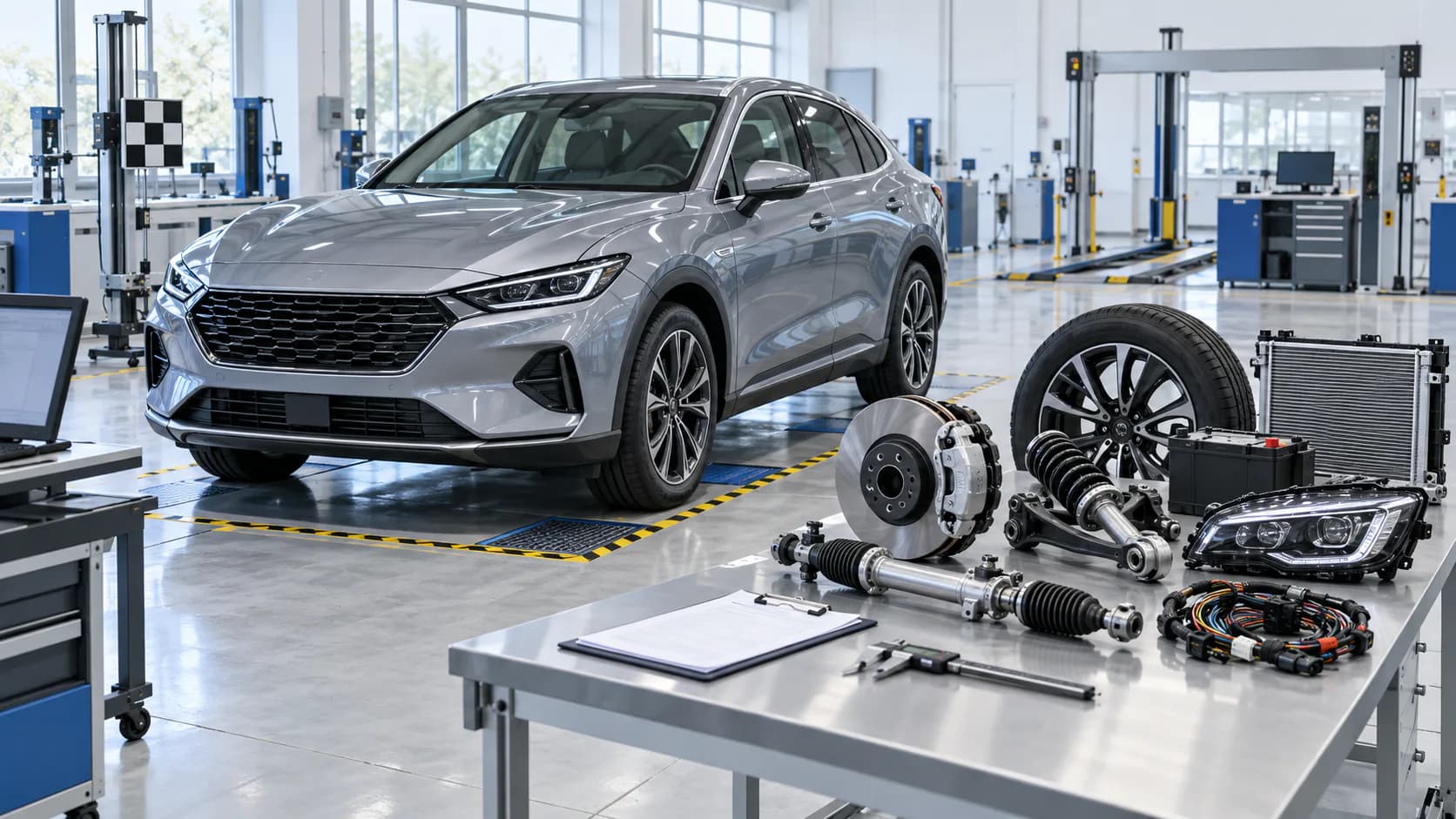
Typical 8708 branches cover bumpers, body parts, brakes, gearboxes, axles, wheels, suspension, radiators, exhausts, clutches, steering and airbags. Tyres of 4011, safety glass of 7007, engines of 8407/8408, engine parts of 8409, bearings of 8482, batteries of 8507, ignition or lighting equipment of 8511/8512 and parts of general use remain outside 8708. The imported article's objective condition controls. A bare casting, complete module, electronic controller and repair kit can fall under different headings even when one vehicle part number links them.
Customs duty, VAT and trade defence
The conventional third-country duty for passenger cars is generally 10%. Auto-part rates are line-specific and commonly around 3%-4.5%, but no universal 8708 rate exists. Import VAT is assessed in the Member State of import on the customs value plus duty and relevant charges. Chinese-origin battery electric vehicles can additionally attract definitive countervailing duties of 7.8%-35.3%, depending on producer and measure details; other AD/CVD measures must be screened by TARIC. Registration, CO2 and ownership taxes are national post-import charges. Preferential duty requires the actual origin rule and proof, not merely shipment from an FTA partner.
EU type approval for vehicles
Regulation (EU) 2018/858 governs approval and market surveillance of category M passenger vehicles and their systems, components and separate technical units. Before placing a type-approved vehicle on the market, the importer must verify a valid EU type-approval and ensure that the vehicle has the required certificate of conformity. A non-conforming vehicle must not be marketed, registered or entered into service until corrected. Individual approval may be available for certain non-EU vehicles, but customs release alone never establishes road-registration eligibility. General safety, emissions, cybersecurity/software and battery obligations may also apply to the precise model.
Compliance for systems and components
A component subject to EU or UN type approval must bear the required approval mark and be accompanied by instructions and safety information in the language required by the destination Member State. The importer must identify itself, preserve approval documentation, handle complaints and recalls, and cooperate with surveillance authorities. Unregulated replacement parts still face the General Product Safety framework where relevant, REACH/POPs restrictions, waste and battery rules, and product-liability duties. Used airbags, pyrotechnic pretensioners, refrigerant units and traction batteries create dangerous-goods and waste-status questions that require separate classification.
Origin and preferential treatment
Customs origin and vehicle manufacturing identity are separate. Preferential origin under an EU agreement requires the product-specific rule, proof of origin and non-manipulation/direct-transport evidence. Non-preferential origin controls marking, trade defence and sanctions. For BEVs and complex parts, retain the bill of materials, manufacturing steps and producer identity. A vehicle assembled in one country from battery cells, drive units or bodies made elsewhere may require different origin analyses for customs duty, trade defence and regulatory type approval.
Customs and technical file
The file should contain invoice, packing list, transport document, valuation, origin proof and product-level description. For vehicles add VIN, model year, seats, propulsion, displacement/power, EU type-approval and CoC or individual-approval basis, emissions and battery data. For parts add part number, drawing, material, function, compatible vehicles, new/used condition and approval markings/certificates. The declaration should separate dissimilar items and include the correct CN/TARIC and additional codes. Recurring high-value imports justify a Binding Tariff Information decision and a documented TARIC measure review.
Member State must be identified
An EU-region page cannot determine final import VAT, registration tax, licensing authority or required language without the Member State of import and first registration. Germany, France, Spain, Italy, Poland and the Netherlands use the common customs tariff but different VAT and vehicle taxes. The destination, importer of record, origin, producer and intended registration date must be fixed before a landed-cost or admissibility conclusion is issued. Transit through one Member State does not automatically make it the VAT or registration jurisdiction.
Official sources
Sources checked on 12 September 2026: EU TARIC, Regulation (EU) 2018/858, Regulation (EU) 2019/2144 and EU guidance on Chinese BEV countervailing duties. The current Combined Nomenclature, TARIC measures, approval-law consolidated text and destination Member State rules must be checked again on the declaration and registration dates.
Limits of the analysis
This is a conditional customs and market-access guide, not BTI, type approval or national registration permission. The final code, tariff stack and legal route require the exact vehicle or part, origin, producer, Member State and import date. The importer remains responsible for classification, origin, customs value, approval, language, traceability, recall and market-surveillance duties.