Classification and import conclusion
Conditional conclusion: a reprogrammable, automatic industrial manipulator capable of several functions through interchangeable tools, and not more specifically covered elsewhere, is a candidate for CN 8479 50 00. The conventional EU third-country customs duty is generally 0%, but TARIC measures, origin, sanctions and the import date must still be checked. Classification does not prove CE compliance. Dedicated welding, handling, spraying, semiconductor or machine-tool robots are classified by their specific function.
When CN 8479 50 00 applies
Apply GIR 1 and 6, Section XVI notes and the imported condition. Record axes, payload, reach, repeatability, programs, controller, tool-change capability and intended tasks. Distinguish a complete robot from an incomplete arm, controller, teach pendant, end-effector, part and integrated cell. A dismantled shipment receives complete-machine treatment only when GIR 2(a) is met; a cell is a functional unit only under Section XVI Note 4. Supplier terminology and a foreign tariff number are evidence, not law.
Functional headings to exclude
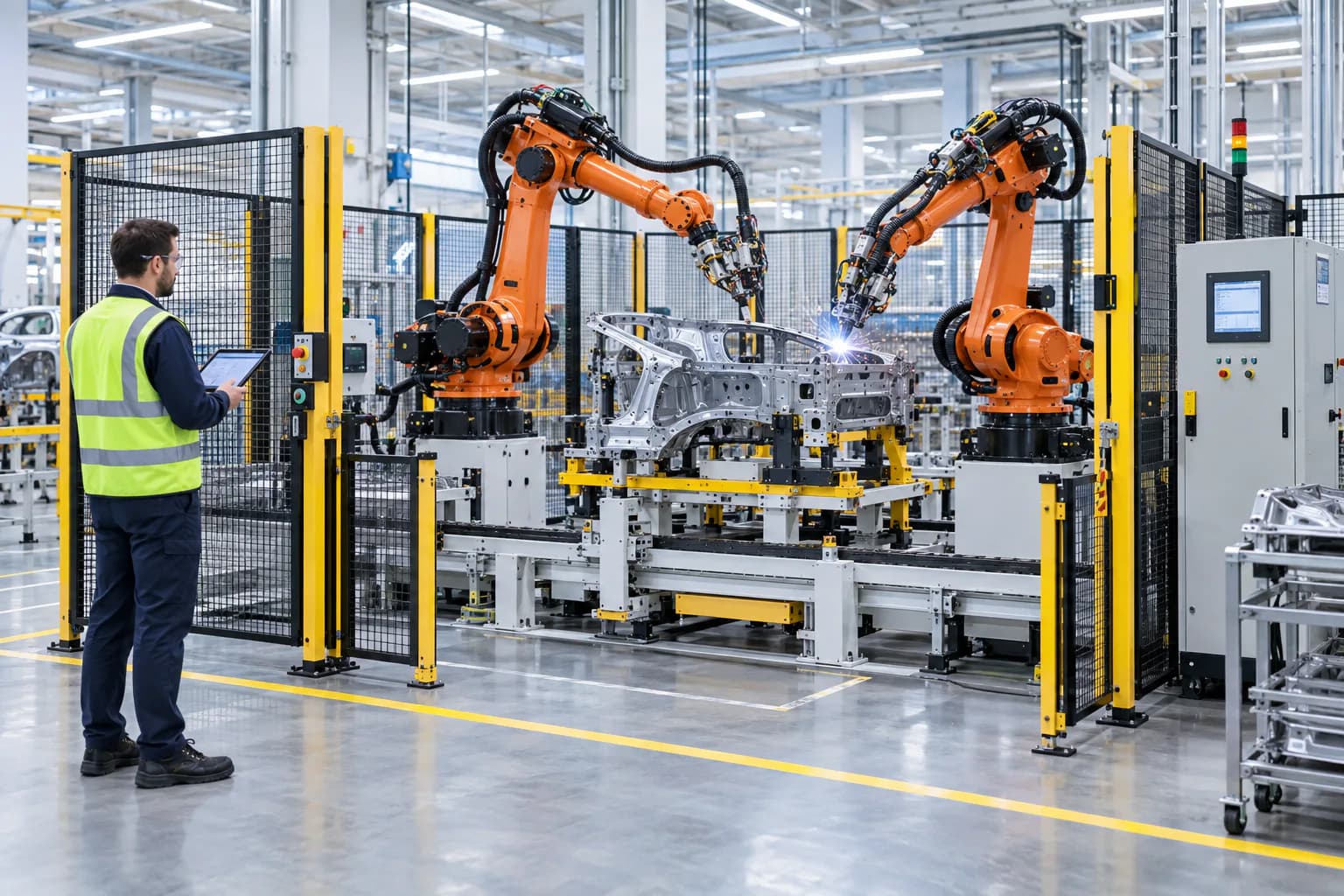
Compare lifting or handling robots with 8428 70, spraying apparatus with 8424, electric welding robots with 8515, semiconductor-manufacturing robots with 8486 and machine tools with the relevant heading. Separately imported grippers, weld guns, vision systems, positioners and guarding need separate classification. The residual 8479 50 route should be documented by excluding each plausible functional heading.
Customs duty and import VAT
Check the ten-digit TARIC code, actual origin and customs value on the entry date. The conventional duty for CN 8479 50 00 is generally Free; anti-dumping, countervailing, suspension, quota and sanctions measures remain separate searches. Import VAT follows the Member State of import and recovery rules. Preferential origin requires a qualifying product rule and proof. Customs value can include assists, software, engineering and royalties where the Union Customs Code conditions are met.
EU machinery-law transition
Machinery placed on the EU market before 20 January 2027 remains under Directive 2006/42/EC; Regulation (EU) 2023/1230 applies from that date. Determine whether the imported item is complete machinery, partly completed machinery or a component, and who becomes manufacturer of the integrated cell. Partly completed machinery normally needs a declaration of incorporation and assembly instructions; the integrator must assess and CE-mark the completed system before use or supply.
CE, technical file and product rules
Typical robot cells also engage EMC Directive 2014/30/EU, Low Voltage Directive 2014/35/EU where applicable, Radio Equipment Directive 2014/53/EU for wireless functions and RoHS/WEEE obligations for electrical equipment. Prepare risk assessment, harmonised-standard matrix, tests, technical file, instructions, traceability, EU Declaration of Conformity and CE marking for the actual configuration. ISO 10218 and ISO/TS 15066 support safety design but do not replace the legal conformity assessment.
Customs file and description
Keep invoice, transport and origin evidence, valuation file, BOM, drawings, task list, software/controller data, tool schedule, cell layout, risk assessment, declarations, tests and instructions. Suggested description: “Six-axis reprogrammable articulated industrial robot for handling and assembly, payload ... kg, with controller, model ..., new, origin ..., CN candidate 8479 50 00.” Identify separately supplied tooling and installation services.
Risk and binding information
Do not use 8479 50 merely because the arm looks robotic. Customs and market-surveillance authorities can inspect software, technical files, guarding and intended function. Obtain Binding Tariff Information where a dedicated task or functional-unit claim creates material risk; BTI does not decide product safety. Contracts should allocate reclassification, duty, conformity-assessment, retrofit, recall and disposal costs and require access to source technical documentation.
Official EU sources
Official sources checked 12 September 2026: EU TARIC, EBTI, Machinery Regulation (EU) 2023/1230, EU machinery safety summary and Blue Guide 2022). Recheck TARIC and legislation before import.
Limits of the analysis
This is conditional general guidance, not BTI or CE approval. A final opinion needs photos, video, datasheet, axes, payload, controller, software, end-effectors, tasks, cell layout, safety functions, wireless/laser content, imported condition, origin, value, Member State and placing-on-market date.