Quick answer
Distinguish a substantially complete programmable robot arm from a mechanical parts assembly, controller and dedicated-function tooling; review duty, Chapter 99, marking and OSHA.
U.S. classification and import answer
“Robot arm” is not a complete tariff description. An articulated arm containing its base, axes, servo motors, drives, transmission and wrist, with the essential character and individual mechanical function of a multipurpose industrial robot, can be classified in HTSUS 8479.50.0000 even without end-of-arm tooling. A skeletal or replacement assembly lacking the components that confer that character requires parts analysis under 8479.90 or the heading of the constituent article. An arm dedicated at importation to welding, lifting, spraying, semiconductor production or another named function follows that function. Ordinary new arms are not categorically prohibited.
Three imported conditions
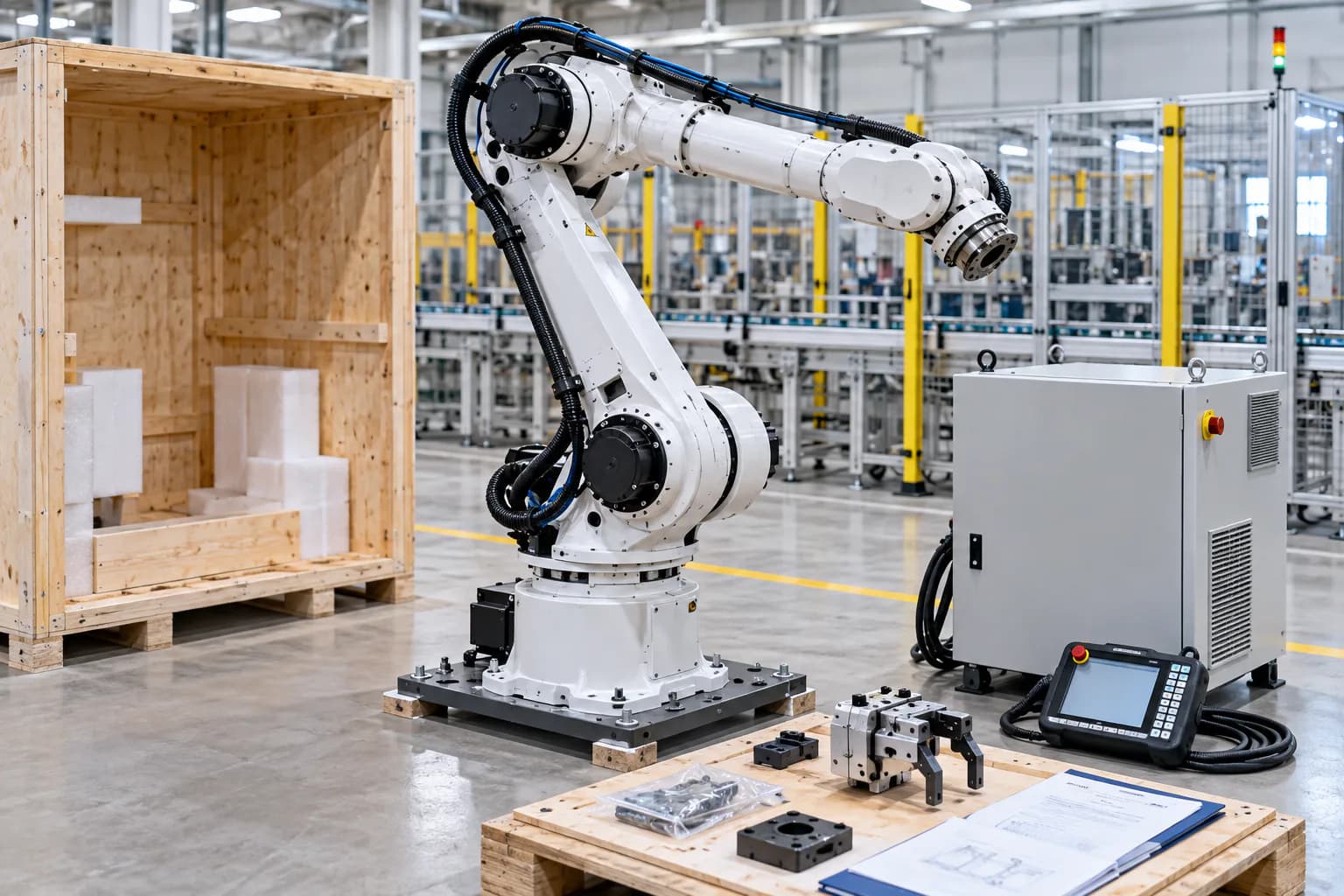
Condition one is a substantially complete driven arm that needs an external controller to operate. Condition two is a mechanical subassembly such as castings, links or joints lacking essential servo drives, reducers or wrist mechanisms. Condition three is an arm entered with tooling and other equipment that establishes one specific service. Classification follows the goods presented together in the entry, not an unsupported description of future use. Separate entries, split invoices and post-import integration cannot be ignored where the facts show an unassembled article or coordinated shipment.
When 8479.50.0000 applies
Apply GRIs 1 and 6, Section XVI notes and GRI 2(a) where incomplete or unassembled. Evidence favoring 8479.50 includes multiple controlled axes, installed actuators and transmissions, a reprogrammable controller interface, interchangeable wrist tooling and capability for different tasks. In N298704, CBP treated industrial robots without end-of-arm tooling as 8479.50 because they were not configured for one specific function. Missing a gripper does not make a complete manipulator a part; the essential-character inquiry remains factual.
When a parts provision applies
A true part is identifiable as solely or principally used with heading 8479 machinery but does not itself have the robot’s essential character. Section XVI Note 2 must be applied before 8479.90: motors, gearboxes, bearings, cables, sensors and electrical apparatus described in their own headings remain there when imported separately. Do not use a parts provision for an almost complete arm merely because a controller is absent. Conversely, cast arm links, empty joint housings, replacement wrists or assemblies lacking core drives may require the relevant 8479.90 statistical line.
Controller and end-of-arm tooling
HQ 962945 classified robot manipulators without welding heads in 8479.50 but classified their separately identifiable controllers in 8537.10, confirming that operational dependence does not automatically create one tariff article. Grippers, weld guns, spray heads, spindles, vision systems, positioners and safety PLCs also require independent classification when separately entered. If arm, controller and tooling arrive together, apply Section XVI Note 4 only where they jointly perform a clearly defined function; a functional unit cannot be classified in residual 8479 merely to avoid the specific function heading.
Duty and Chapter 99
The current Column 1 General rate for 8479.50.0000 is Free; confirm the exact 8479.90 or 8537.10 line because rates can differ. Query Chapter 99 by eight-digit number, actual country of origin and entry date. Chinese-origin goods may face Section 301 unless a current exclusion applies; AD/CVD scope remains separate. MPF applies and HMF may apply to ocean cargo. Customs value may include tooling, assists, engineering, software and royalties. A zero base rate does not eliminate entry, valuation or origin obligations.
Origin, UFLPA and machine safety
Mark actual origin under 19 U.S.C. 1304 and 19 CFR Part 134, analyzing substantial transformation of castings, servo motors, reducers, controls and final assembly. UFLPA and 19 U.S.C. 1307 require supply-chain records where relevant. OSHA has no single robot standard, but 29 CFR 1910 machine guarding, hazardous-energy control and electrical rules apply to the installed system. Validate fencing, interlocks, teach mode, emergency stop, restart prevention and collaborative limits with ANSI/RIA R15.06, ISO 10218 and the actual tool/workpiece.
Entry file and recommended description
Keep invoice, packing list, bill of lading, bond, BOM, exploded drawing, drive list, axes, payload, reach, repeatability, controller interface, supported programs, compatible tooling, photos of every crate, origin production records, valuation and safety file. Suggested description: “Six-axis articulated industrial robot arm with installed servo motors and joint drives, reprogrammable and suitable for interchangeable end effectors, payload ... kg, model ..., without controller or gripper, new, origin ..., HTSUS candidate 8479.50.0000.” Describe missing components expressly.
Official U.S. sources
Official sources checked 12 September 2026: 2026 HTSUS, CBP N298704, CBP HQ 962945, EOS of North America v. United States, OSHA robotics and USTR Section 301 search. Recheck the live HTS revision and agency measures before entry.
Limits and ruling strategy
This is conditional general guidance, not a binding ruling. A final opinion requires photos, cross-sections, BOM, installed servos/reducers, axes, controller, software, tooling, intended tasks, imported configuration, coordinated shipments, origin stages, value and entry date. Where the distinction between machine and part is material, request a CBP ruling using a representative sample and complete diagrams. The importer remains responsible.
Official sources to verify
- WCO — HS Nomenclature 2022 and General Rules for Interpretation
- United States International Trade Commission — Harmonized Tariff Schedule
Editorial note
Prepared by the Global HS Code Checker Editorial Team for customs-classification, tariff and import-policy research. The correct code and applicable measures may change with the merchandise's actual characteristics, jurisdiction, entry date and supporting record. Verify the current tariff, governing measures and competent customs authority before filing an entry. A reviewer is identified only after a named expert has completed the review.