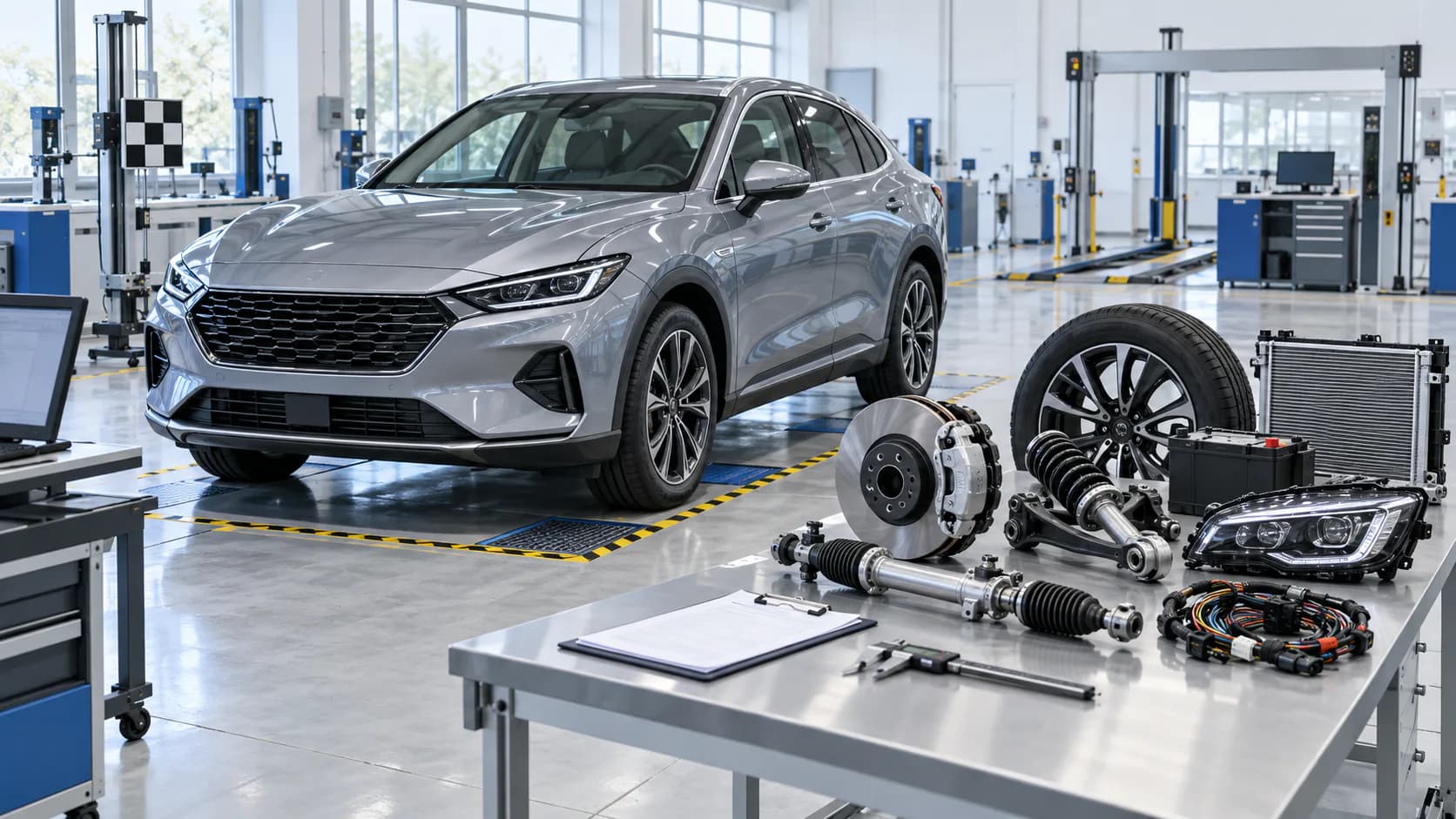
Classification conclusion and import answer
Conditional conclusion: a motor vehicle principally designed to carry people, with nine or fewer seats including the driver, normally falls in heading 8703. The final ten-digit HTSUS number depends on propulsion, cylinder capacity, new/used condition and body configuration. A component belongs in heading 8708 only if it is identifiable as suitable for use solely or principally with vehicles of headings 8701-8705 and is not excluded by Note 2 to Section XVII. A vehicle and its parts therefore cannot share one universal duty rate or admission rule.
| Product branch | Candidate HTSUS | Decisive facts |
|---|---|---|
| Passenger vehicle | 8703.21-8703.90 | Propulsion, displacement, new/used, body and seating |
| Vehicle-specific part | 8708.10-8708.99 | Function, vehicle fitment and Section XVII exclusions |
| Separately provided article | 40, 70, 73, 84 or 85 | Tires, glazing, engines, batteries, electrical goods and general-use parts |
How to select the passenger-car HTSUS provision
GRI 1 starts with heading 8703, not the seller's description. Spark-ignition vehicles separate under 8703.21-.24, diesel vehicles under 8703.31-.33, non-plug-in hybrids under 8703.40/.50, plug-in hybrids under 8703.60/.70, battery-electric vehicles under 8703.80 and other propulsion under 8703.90. GRI 6 then applies the U.S. subheading language, including cylinder capacity, body style and used status. Ten or more persons points toward 8702; a vehicle principally for cargo may be 8704; a vehicle having a specialized non-transport function may be 8705. A disassembled or incomplete vehicle can still be classified as the complete vehicle under GRI 2(a) when it has the essential character.
When an auto part belongs in heading 8708
Heading 8708 covers bumpers, body parts, brakes, gearboxes, drive axles, wheels, suspension, radiators, exhaust systems, clutches, steering, airbags and residual parts. It does not absorb every item installed on a car. Section XVII excludes tires of 4011, safety glass of 7007, engines of 8407/8408, engine parts of 8409, bearings of 8482, batteries of 8507, ignition equipment of 8511, lighting/signalling equipment of 8512 and parts of general use such as fasteners of 7318. Each imported condition matters: a complete assembly, a bare casting and a repair kit may have different classifications. Part number and compatibility evidence support use, but they do not override the legal notes.
Base duty, Section 232 and Chapter 99
The ordinary Column 1 rate for many passenger cars is 2.5%, while 8708 rates vary by exact ten-digit line. This is only the first layer. Proclamation 10908 imposed an additional 25% Section 232 duty on covered automobiles from 3 April 2025 and covered automobile parts from 3 May 2025, subject to Chapter 99 scope, exclusions, origin arrangements and later amendments. Country agreements may produce a different combined treatment. The importer must run the exact HTSUS line, country of origin and entry date through the current USITC HTSUS and Chapter 99 notes; a base-rate quotation is not a landed-duty opinion.
Other import charges and trade remedies
Merchandise processing fee and harbor maintenance fee may apply depending on entry and transport mode. Additional duties can arise under Section 301, Section 232 metals, antidumping/countervailing orders or safeguards, and more than one Chapter 99 provision may need to be reported. AD/CVD scope turns on the merchandise and producer/exporter, not merely heading 8708. Customs value must include assists, royalties and related-party adjustments where required. State sales/use tax and registration charges are post-entry matters and should not be presented as customs duty. For a Chinese-origin vehicle or part, review current Section 301 treatment and UFLPA separately rather than assuming the ordinary rate is the total.
NHTSA and EPA vehicle admissibility
A road vehicle less than 25 years old must have been manufactured and certified to all applicable FMVSS, bumper and theft-prevention standards, or be determined eligible and imported through a Registered Importer with the required bond. The importer files DOT Form HS-7. The 25-year NHTSA age exception runs from the manufacture date and does not create an EPA exception. EPA separately requires conformity with Clean Air Act emissions requirements and EPA Form 3520-1; the 21-year original-configuration rule is distinct. Review NHTSA's importing-vehicle guidance and EPA vehicle-import forms before shipment, not after arrival.
Motor-vehicle equipment compliance
Motor-vehicle equipment subject to an FMVSS must conform and be certified by its manufacturer. NHTSA identifies brake hoses and fluid, glazing, lighting, seat-belt assemblies, tires and rims among regulated items. Theft-prevention marking may apply to specified replacement parts under 49 CFR Part 541. An on-road vehicle shipped with engine and drivetrain remains a motor vehicle even when described as “for parts”; removing engine and drivetrain may create an equipment assemblage, but each regulated item remains subject to its own standard. EPA generally does not regulate ordinary parts as motor vehicles, while engines, catalytic/emissions components, refrigerants, batteries and hazardous materials can trigger separate EPA, DOT/PHMSA or other controls.
Entry documents and auditable description
The entry file should include invoice, packing list, bill of lading, valuation support, origin evidence and exact part-level descriptions. A vehicle file needs VIN, model year, make/model, seating, fuel, engine displacement/power, EPA label or exemption basis, FMVSS certification label, HS-7 and 3520-1. A parts file needs part number, drawing, material, function, vehicle fitment, new/used condition, FMVSS certification where applicable and producer/exporter identity for trade-remedy screening. Describe the objective article rather than “auto parts”; separate dissimilar lines on the invoice and entry. Obtain a CBP binding ruling when recurring value and classification risk justify it.
Origin, marking and supply-chain controls
Country of origin is a legal conclusion based on the applicable origin rule; shipment through a third country does not change it. Mark the article or container under 19 U.S.C. 1304 and 19 CFR Part 134 unless an exception applies. For vehicles and parts using steel, aluminum, electronics or battery supply chains, retain bills of materials and manufacturing records sufficient to support Chapter 99, Section 232 and substantial-transformation claims. Screen entities and polysilicon/battery inputs under UFLPA and Withhold Release Orders when relevant. False origin, undervaluation or omission of additional duties can produce penalties, detention and False Claims Act or criminal exposure.
Official sources
Primary sources checked on 12 September 2026: USITC HTSUS, Presidential Proclamation 10908 on automobiles and parts, NHTSA import and certification FAQs, EPA vehicle and engine import forms, CBP CROSS and the current ACE/Chapter 99 instructions. The live tariff and Federal Register must be rechecked on the entry date.
Limits of this guidance
This article is a conditional screening guide, not a binding CBP ruling, NHTSA eligibility determination or EPA approval. A final ten-digit code and landed-duty calculation require the exact vehicle/part, origin, producer/exporter and entry date. Vehicle admissibility requires the actual certification labels and forms. Importer of record remains responsible for classification, value, origin, admissibility and all Chapter 99 reporting.
Editorial note
Prepared by the Global HS Code Checker Editorial Team for customs-classification, tariff and import-policy research. The correct code and applicable measures may change with the merchandise's actual characteristics, jurisdiction, entry date and supporting record. Verify the current tariff, governing measures and competent customs authority before filing an entry. A reviewer is identified only after a named expert has completed the review.