Quick answer
Distinguish a bare GPU integrated circuit from a laptop graphics PCB or external processing unit; review duty, Chapter 99, origin, FCC and advanced-chip controls.
Classification and duty conclusion
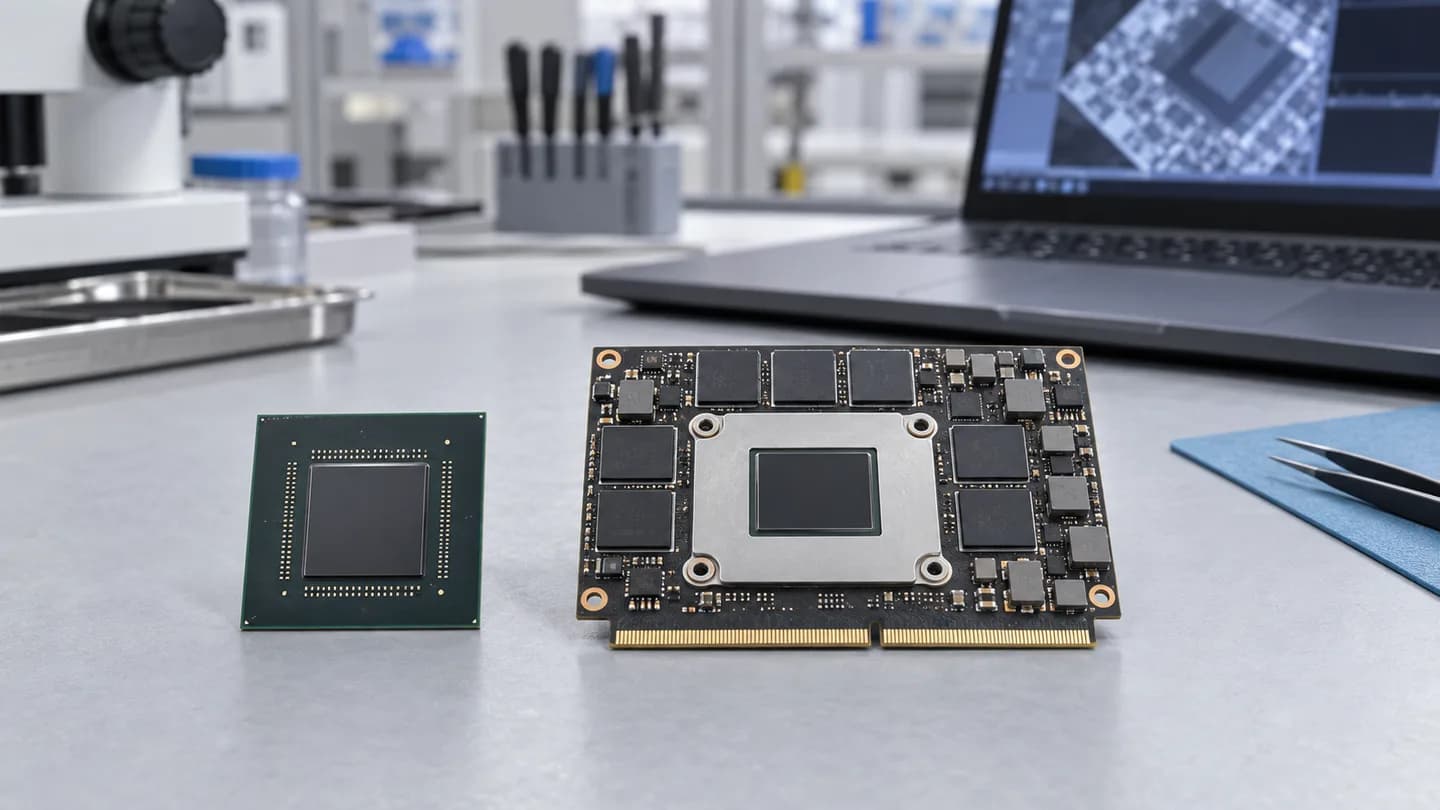
“Laptop GPU” is not one tariff article. A bare packaged graphics processor that is an electronic integrated circuit is classified in HTSUS 8542.31 under the current statistical breakout and ordinarily enters Free. A populated laptop graphics PCB may fall in 8473.30.1180 as a printed circuit assembly, while a separately functioning external graphics unit may require heading 8471. The importer must use the 2026 HTS statistical suffix matching the merchandise on the entry date.
Bare chip, graphics module or complete unit
GRI 1 and Chapter 85 Note 12 support heading 8542 for an indivisible integrated circuit whose processor function is performed within the semiconductor package. A board carrying a GPU, VRAM, voltage regulators and connectors is no longer the bare IC. Determine whether it is a part principally used with heading 8471, a printed circuit assembly, or a complete ADP unit by its interfaces and independent functions. A GPU soldered to a laptop motherboard is classified with that imported motherboard rather than separately.
Duties and entry fees
The Column 1 general duty for the principal semiconductor and computer-parts branches is generally Free, but this is not the landed-duty total. Budget Merchandise Processing Fee and Harbor Maintenance Fee for applicable vessel entries. China- and Hong Kong-origin goods require an entry-date review of Chapter 99, including Section 301 and any IEEPA measure then in force. Additional duties turn on legally determined origin, not the shipping country, and exclusions must match the exact HTS provision and product scope.
Product regulation and marking
A bare GPU or non-radio graphics module does not ordinarily require FCC equipment authorization merely because it is electronic. A finished digital device or external enclosure can be an unintentional radiator subject to FCC Part 15, and any incorporated wireless function requires its own analysis. Mark foreign origin under 19 U.S.C. 1304 and 19 CFR part 134 unless a valid exception applies. Safety, EMC and voluntary certifications must identify the exact model and configuration.
Advanced-computing controls
U.S. advanced-computing rules administered by BIS primarily control exports, reexports and transfers, not routine customs admission of an ordinary replacement GPU. Nevertheless, high-performance AI accelerators, military or radiation-hardened designs, restricted parties and sanctioned destinations require ECCN, end-user and end-use screening. Do not infer export-control status from HTSUS alone. Origin analysis should document wafer fabrication, assembly, packaging, testing and PCB manufacturing when Chapter 99 or marking is material.
Entry support file
Retain invoice, packing list, transport and valuation records; exact part-number datasheet; photographs and package/PCB drawings; architecture, processing performance, memory capacity/bandwidth, interconnects, power and cooling requirements; BOM and manufacturing flow; wafer, package, test and PCB locations; condition evidence; origin analysis; FCC and export-control screening where applicable. Obtain a CBP binding ruling when the module-versus-unit boundary materially affects treatment.
Declaration descriptions
Bare chip example: “Electronic integrated circuit graphics processor for laptop computers, BGA package, part number ..., not mounted on PCB, new.” Module example: “Populated printed circuit assembly principally used with laptop computers, incorporating GPU ..., ... GB VRAM, power circuitry and connector ..., model ..., new.” Avoid “video card” when the imported article is only a chip or an entire motherboard.
Official sources
Sources reviewed September 22, 2026: USITC HTSUS; CBP CROSS rulings; CBP Section 301 FAQs; 19 CFR part 134; FCC equipment authorization; BIS advanced-computing controls.
Editorial note
Prepared by the Global HS Code Checker Editorial Team for customs-classification, tariff and import-policy research. The correct code and applicable measures may change with the merchandise's actual characteristics, jurisdiction, entry date and supporting record. Verify the current tariff, governing measures and competent customs authority before filing an entry. A reviewer is identified only after a named expert has completed the review.