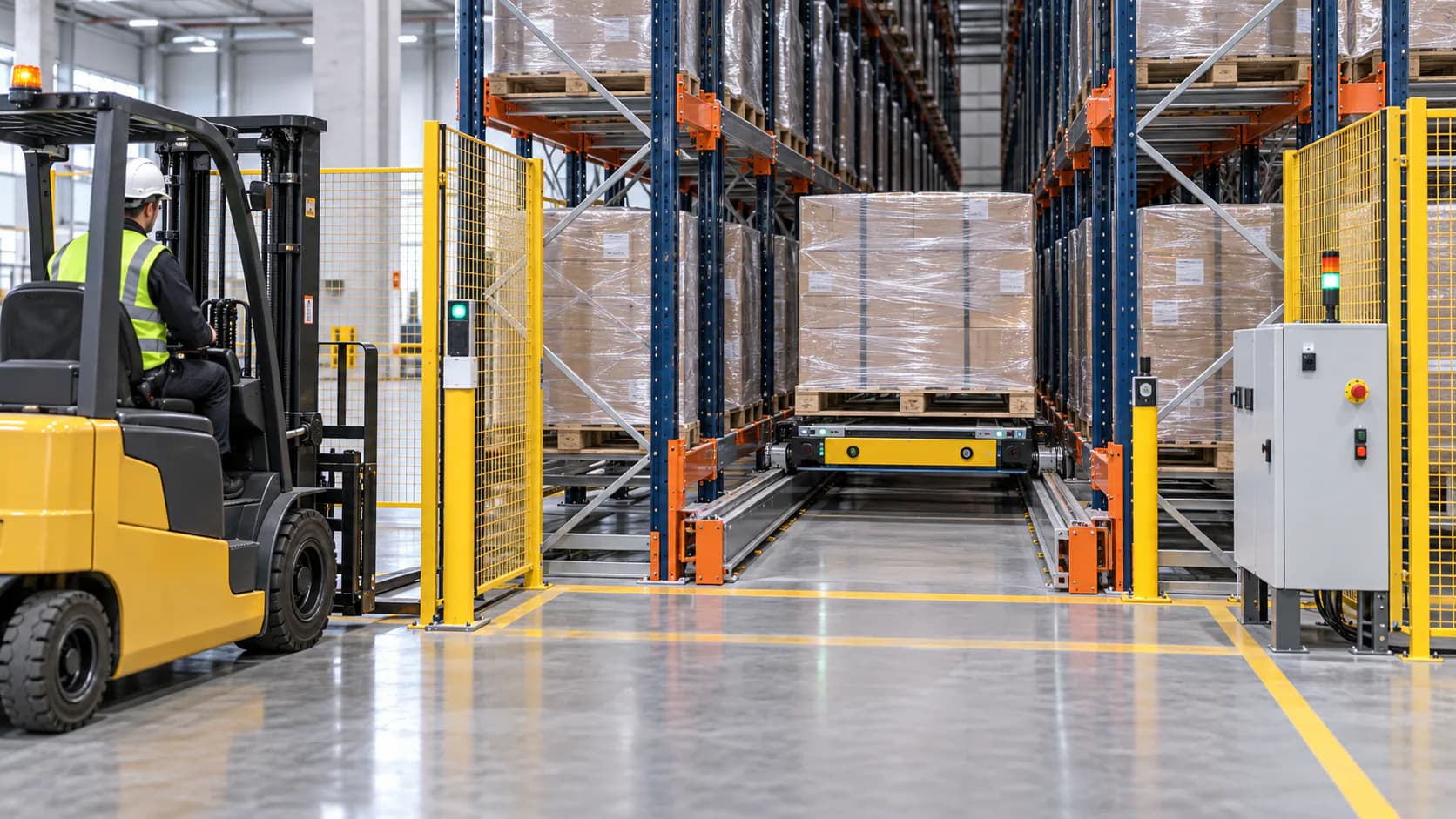
Classification and import conclusion
A battery-powered pallet shuttle that propels itself on rails inside storage rack and lifts pallets is first analysed in HS 8427.10 and, under the EU Combined Nomenclature, typically CN 8427 10 90. A complete AS/RS imported as an interconnected functional unit may instead require heading 8428. Static rack, control cabinets, batteries and separately entered parts require their own classification. The word “robot” does not establish CN 8428 70.
Define the imported configuration
Separate a shuttle entered alone from a project containing vertical lifts, conveyors, transfer cars, WCS software, safety fencing, rails and rack. The referenced Radio Shuttle receives a command, runs beneath a pallet, raises it a short distance and moves it within a deep-lane rack while the forklift remains at the aisle entrance. Apply CN General Rules 1, 2(a) and 6 and Section XVI Notes 2 to 4 to the goods as presented, not to a sales label or their possible condition after installation.
Pallet shuttle classification
CBP ruling N353392 classified a nearly identical battery-driven four-way pallet shuttle in HS 8427.10: it was self-propelled, ran on rack rails, used sensors and lifted a 1,500 kg pallet by 43 mm. The ruling is not binding in the EU but supplies persuasive technical evidence at the harmonised six-digit level. Document the drive motor, battery, wheels, rail path, payload, lift stroke and handling platform. A trolley without lifting or handling equipment may require a different heading.
Complete AS/RS and functional-unit rule
Section XVI Note 4 permits a combination of machines to be classified by a clearly defined function where the components are interconnected and contribute together. Thus a genuine automated storage and retrieval installation may fall in heading 8428. One supply contract or common software alone does not absorb static rack or independent machines into one code. Explain mechanical and data links, the process flow and import consignments; examine GRI 2(a) where an unassembled system is presented and avoid unsupported aggregation across later shipments.
Rack, controls, battery and parts
Parts used solely or principally with heading 8427 machinery may fall in 8431 20, subject to Section XVI Note 2. Motors, lithium batteries, chargers, sensors and electrical controls named in their own headings stay there when entered separately; a low-voltage control cabinet commonly requires 8537 10 analysis. Floor-standing metal storage furniture may fall in 9403 20, while structural, fixed steel rack can raise heading 7308. Anchoring, load-bearing design and whether the article furnishes a space are material facts.
Customs duty, preference and VAT
The working candidate is CN 8427 10 90. The Common Customs Tariff third-country duty is commonly shown at 4.5%, but the legally payable rate must be retrieved from live TARIC using origin and declaration date; preference may reduce it if origin rules and proof are met. The Member State of import's standard import VAT is the destination Member State's standard rate and is generally calculated on customs value plus duty and incidental costs. Import VAT cannot be reduced to one EU-wide percentage. TARIC, not a static article, controls suspension, quota, anti-dumping or other additional measures.
Import controls and conformity
New ordinary warehouse machinery is not generally prohibited merely by code, but TARIC must be checked for origin-specific trade defence, sanctions and surveillance. EU machinery, electrical, EMC, radio and battery rules may apply component by component. Through 19 January 2027 the Machinery Directive 2006/42/EC remains the central machinery regime; Regulation (EU) 2023/1230 applies from 20 January 2027. Confirm CE conformity, technical file, declaration, instructions and importer identification before placing on the market.
Machinery and warehouse safety
Risk assessment must cover rack load, rail deflection, pallet fall, collision, forklift interface, trapping, unexpected restart, emergency stop, energy isolation, charging and fire. EN 528, EN 15635 and ISO 3691-4 provide relevant technical methods depending on the final system. The integrator must assess the assembled installation, not only collect declarations for individual components. Software changes, remote operation and substantial modification can alter the responsible economic operator and conformity obligations.
Customs file and product description
Retain contract, invoice, packing list, transport document, BOM by crate, photos, layout, control architecture, payload, lift stroke, motor and battery data, wireless specifications, origin evidence, valuation additions and conformity file. Suggested description: “Battery-powered self-propelled pallet shuttle operating on rails within warehouse rack, with integral platform lifting and transporting pallets, payload ... kg, lift ... mm, model ..., new, origin ...”. List rack, control panels, charger, battery and spares separately where required.
Official sources
Official sources checked 12 September 2026: EU TARIC, Combined Nomenclature classification, EBTI, Machinery Regulation (EU) 2023/1230 and CBP N353392.
Limits and BTI strategy
This is conditional guidance, not a binding classification. The final CN/TARIC code and duty require the exact imported condition, technical drawings, shipment plan, rack anchoring, origin and customs date. For a material project, request Binding Tariff Information before shipment and obtain a separate conformity review of the integrated installation. Search optimisation cannot guarantee indexing, ranking or quotation.