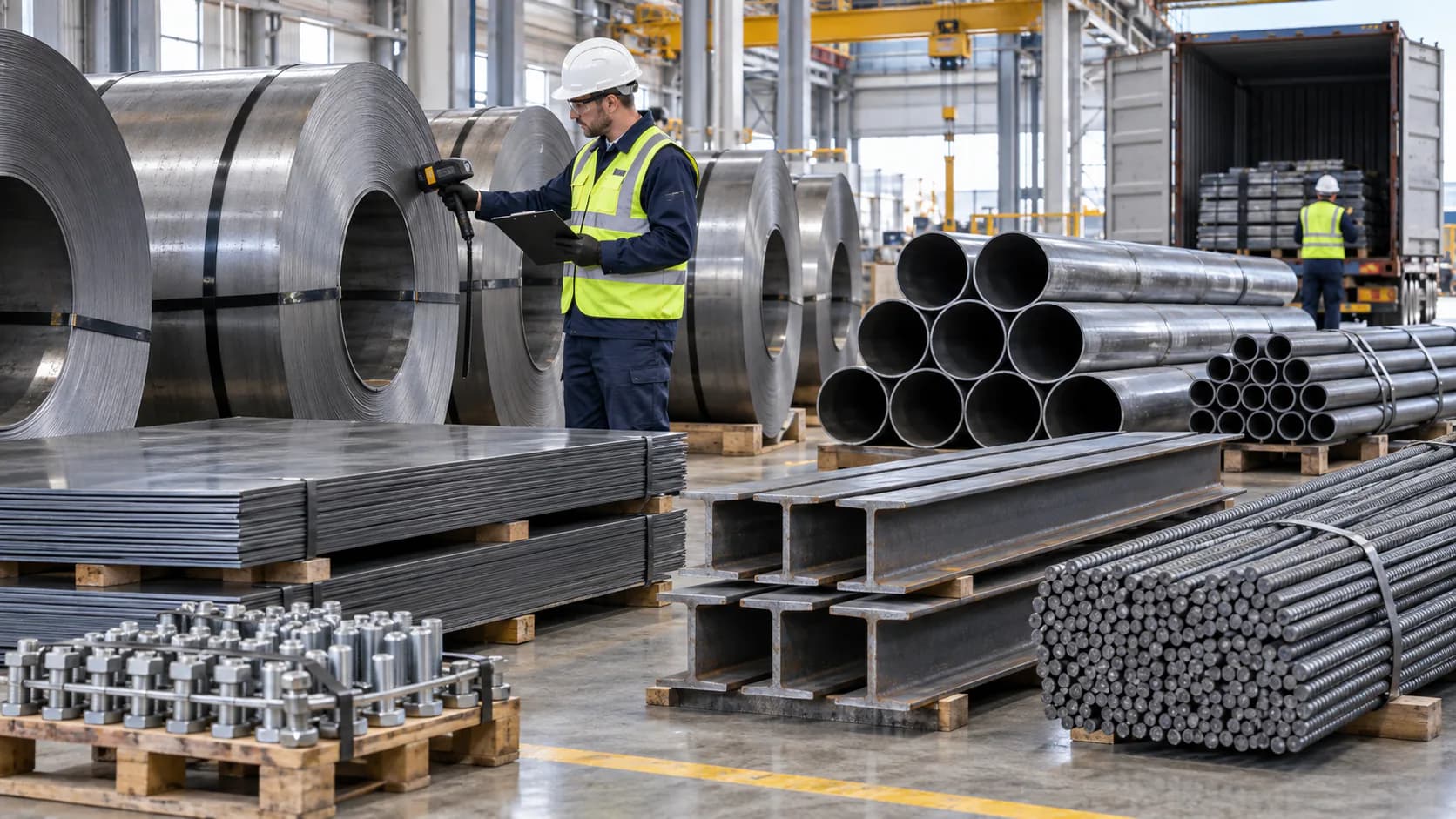
Quick answer: CN code and import rules
Conditional answer: iron and steel does not have one CN or TARIC code. Basic iron, semifinished and rolled products generally fall in Chapter 72; pipes, structures, containers, fasteners and other articles generally fall in Chapter 73. Chemistry, form, dimensions, manufacturing, coating and completion select the eight-digit CN and TARIC measures. Importers must then check conventional duty, the steel quota measure effective from 1 July 2026, AD/CVD, CBAM, origin, import VAT and any sectoral conformity rule.
| Form | Candidate headings | Key evidence |
|---|---|---|
| Pig iron, ferroalloys, DRI, scrap | 7201-7204 | Chemistry and condition |
| Flat products, bars, wire, alloy steel | 7205-7229 | Dimensions, rolling, coating, alloy |
| Pipes, structures, fasteners, other articles | 7301-7326 | Construction, function, completion |
Deciding between CN Chapters 72 and 73
Apply GIR 1, Section XV and Chapter notes, followed by GIR 6. Distinguish width of 600 mm, hot/cold rolling, plating/coating, solid/hollow cross-sections, seamless/welded tubes and stainless/other alloy chemistry. A fabricated item identifiable as a machinery part may leave Chapter 73. Supplier codes and EN grade names are evidence, not the legal classification. Where the same description spans CN subdivisions, a BTI can provide prospective classification certainty but does not decide origin or trade-remedy scope.
Review the technical documents before classification
Secure the mill test certificate, heat analysis, grade, carbon/chromium/alloy content, dimensions, cross-section, coil/sheet/bar status, rolling/drawing/forging/casting, weld type, coating, machining, intended use and photographs. Pipes need outside diameter and wall thickness; structures need assembly drawings. Reconcile heat/coil numbers, producer, country of melt/pour and invoices. Missing chemistry or dimensions means only candidate headings can be stated.
Customs duty, preference and import VAT
The Common Customs Tariff and preferential duty depend on the full CN/TARIC code, origin, customs value and acceptance date. Preference requires a valid origin rule and proof. Import VAT is levied under the destination Member State's rules and taxable base; deferment or postponed accounting depends on national authorisation. A zero conventional duty does not remove safeguard, AD/CVD or CBAM obligations. Use TARIC on the filing date rather than a representative Chapter 72 rate.
EU steel measure from 1 July 2026
Regulation (EU) 2026/1384 replaced the former safeguard from 1 July 2026. It establishes tariff-free quotas across 30 steel categories, totalling 18.3 million tonnes annually, and a 50% out-of-quota duty, subject to category, allocation, country treatment and stated exclusions. The EEA is excluded and FTA treatment requires the Regulation's conditions. Separately compare every anti-dumping or countervailing measure by written product scope, origin and producer; CN references alone are not conclusive.
CBAM obligations from 2026
The definitive CBAM regime began on 1 January 2026 and covers listed iron and steel CN codes and certain downstream products. Importers above the applicable mass threshold generally need authorised CBAM declarant status; embedded emissions, production installation and carbon price evidence must be reported and certificates surrendered according to the definitive timetable. Do not infer coverage from the word steel alone: check Annex I and exclusions using the exact CN code. Keep verifiable mill-route and emissions data contractually available before shipment.
Trade remedies and product conformity
Steel as a material is not subject to one EU-wide import permit. Construction products covered by a harmonised technical specification may require assessment, Declaration of Performance/Performance and Conformity, CE marking and traceability under Regulation (EU) 2024/3110 and its transition from the prior CPR. Pressure equipment, automotive parts, machinery components and food-contact articles follow their own sectoral regimes. REACH restrictions and substances in coatings may apply. Trade-remedy clearance does not prove product conformity.
Scrap, waste and environmental controls
Waste and scrap heading 7204 requires a separate waste-status analysis. Determine whether the consignment is product, by-product, end-of-waste material or waste; waste shipments can trigger Regulation (EU) 2024/1157, notification/consent, destination and documentary controls. Re-labelling mixed or contaminated scrap as secondary raw material does not remove waste law. Obtain source-process records, contamination/radiation tests, photographs and a destination-recovery contract.
Import file and declaration description
Keep invoice, packing list, transport document, origin proof, MTC, chemistry, drawings, dimensions, coating and processing records, producer/exporter identity, quota and trade-remedy screen, CBAM data and conformity evidence. Suggested declaration: ‘Non-alloy hot-rolled flat steel in coils, not clad/plated/coated, width ... mm, thickness ... mm, grade ..., carbon ...%, EN ..., heat/coil ..., melt/pour country ..., use ..., new goods.’ Adapt decisive fields for tubes, structures or fasteners; ‘steel products’ is insufficient.
Official EU sources
Official materials checked 12 September 2026: EU TARIC and Access2Markets, Regulation (EU) 2026/1384 steel measure, EU steel-measure factsheet, CBAM definitive regime and Construction Products Regulation portal. TARIC, quota balance, CBAM status, trade-remedy rates and national VAT must be rechecked on the declaration date.
Limits of this guidance
This guide is not a BTI, origin decision, CBAM authorisation or trade-remedy scope ruling. A final opinion requires a sample, MTC, chemistry, dimensions, production method, coating, completion, use, origin, producer, value and import date. Small changes in alloy content, width, thickness, rolling, weld or fabrication can change both CN and measures. The declarant remains responsible for complete and accurate data.