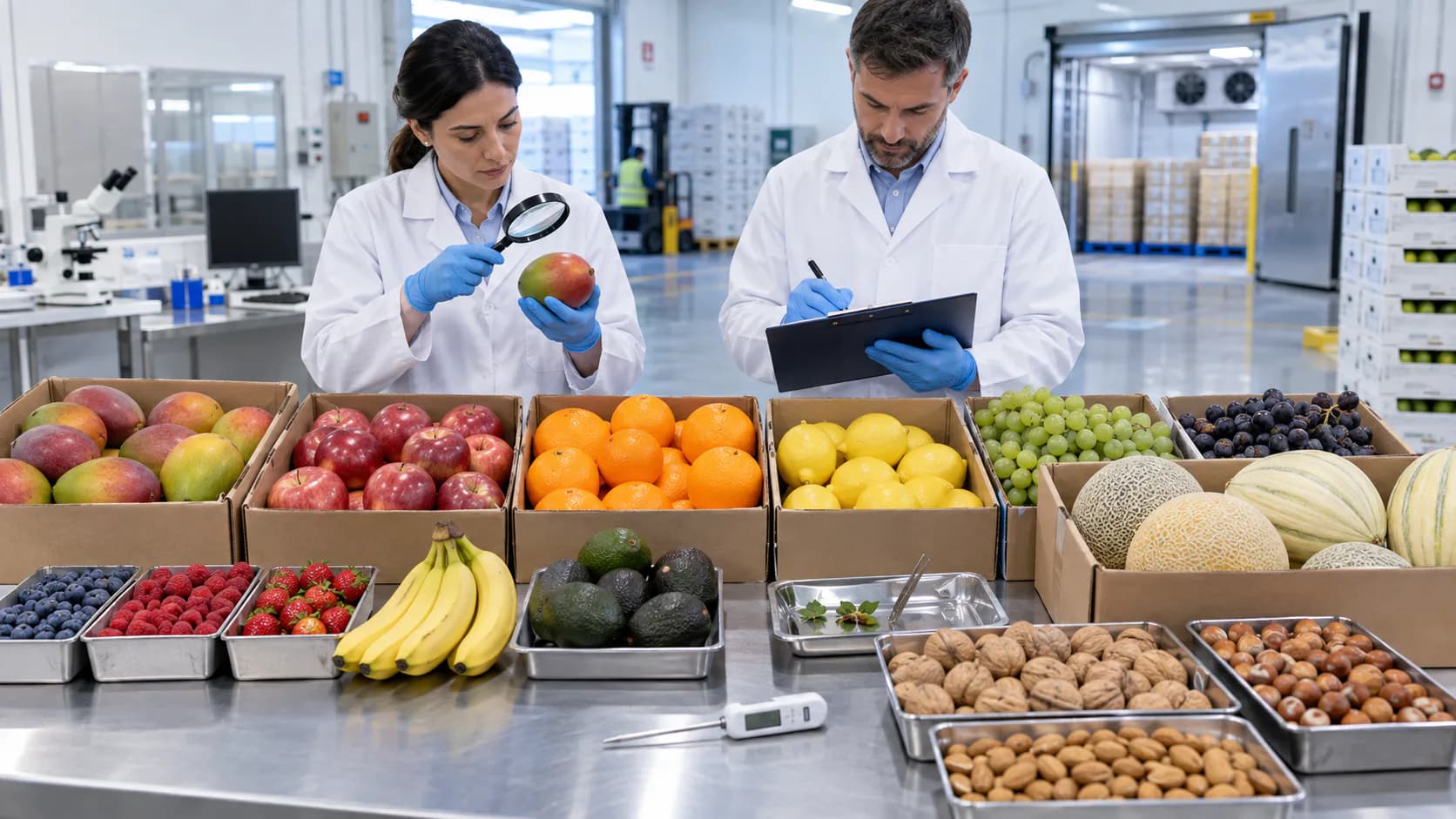
Quick answer: CN code and import
Conditional answer: fresh fruit, edible nuts and citrus or melon peel may fall in CN Chapter 08, but there is no single eight-digit CN code or common duty. Species, physical condition, shell, additives and processing decide classification. For plant health, most fresh fruit from non-EU countries needs a phytosanitary certificate and compliance with Regulation (EU) 2019/2072; the general certificate exception is limited to pineapple, coconut, durian, banana and dates. A tariff code does not establish phytosanitary admissibility.
| Product | Candidate headings | Decisive facts |
|---|---|---|
| Coconuts, Brazil nuts, cashews; other nuts | 0801-0802 | species, shell and condition |
| Bananas; dates, figs, pineapple, avocado, mango | 0803-0804 | species and fresh/dried state |
| Citrus, grapes, melons and papayas | 0805-0807 | variety, season and state |
| Apples, pears, stone fruit, other fresh fruit | 0808-0810 | species and presentation |
| Frozen, provisionally preserved, dried; peel | 0811-0814 | preservation and additions |
How to determine the code in Chapter 08
Apply General Rules 1 and 6, the Chapter 8 notes and the wording of the headings and subheadings. Frozen fruit generally enters 0811, provisionally preserved fruit unsuitable for immediate consumption 0812, dried fruit and mixtures 0813, and citrus or melon peel 0814. Cooking, pulping, syrup, substantial preparation or preservation can move goods to 2008; juice is in 2009. Tomatoes and cucumbers are classified in Chapter 07 despite botanical terminology. Supplier HS codes and plant-health product codes do not determine CN classification.
Review the technical documents before selecting the CN code
Record common and botanical name, cultivar, whole/cut/mixed form, fresh/chilled/frozen/dried condition, temperature, in-shell/shelled/roasted status, sugar, salt, sulfites, oil, seasoning or preservatives, packaging and use. Identify production country and area, grower/orchard, packing station and treatment, harvest period, marks, wood packaging and route. Specifications, photographs, invoice, packing list, phytosanitary certificate and treatment data must describe the same lot. The CN line can change when fruit is frozen, dried or prepared.
TARIC duty, entry price, preference and VAT
TARIC must be checked on the acceptance date using the full CN/TARIC code, origin, customs value, net mass and preference. Chapter 08 includes ad valorem and specific duties, seasonal rates, entry-price mechanisms, tariff quotas, safeguards and preferential rates. Proof of origin must meet the relevant agreement; dispatch from a beneficiary is insufficient. Import VAT is imposed by the Member State of clearance at its national rate and is not contained in TARIC. Do not quote a single duty or VAT rate for all fruit, nuts and all EU destinations.
Plant-health certificate and prohibited pathways
Under the Plant Health Regulation and Implementing Regulation 2019/2072, most fresh fruit from third countries must arrive with an original phytosanitary certificate and be presented for official controls. The certificate exception for five fruits does not waive customs, food or marketing rules. Annex VI prohibitions, Annex VII special requirements, pest-free areas, additional declarations, treatment and emergency measures depend on the commodity-origin pairing. The importer must check TRACES NT/CHED-PP routing, the competent Border Control Post or Control Point and advance notification requirements before dispatch.
Border control and marketing standards
Official controls under Regulation (EU) 2017/625 may include documentary, identity and physical checks, sampling and plant-health fees. Fresh fruit and vegetables placed on the EU market must satisfy the applicable general or specific marketing standards under Regulations 2023/2429 and 2023/2430, including quality, maturity, tolerances, origin and package presentation; conformity checks may occur at import. A phytosanitary release does not establish marketing conformity, and a conformity certificate does not replace plant-health or customs clearance.
Food safety, residues, traceability and labels
Food must be safe and traceable under the General Food Law, observe pesticide MRLs in Regulation 396/2005, contaminants in Regulation 2023/915 and hygiene rules in Regulation 852/2004. Product identity, country of origin where required, lot and responsible food business operator must not mislead; prepacked products require the applicable food information. Importers should maintain supplier approval, residue monitoring, treatment records, temperature logs and recall contacts. Rapid Alert or increased-control measures can change documentary and sampling requirements by product and origin.
Customs file and recommended description
Keep contract, invoice, packing list, transport document, EORI, customs valuation and origin proof, botanical specification, phytosanitary certificate, TRACES/CHED-PP records, treatment and pest-free evidence, grower and packer details, conformity documents, residue reports, labels and cold-chain logs. Suggested description: “Fresh mangoes (Mangifera indica), cultivar ..., whole and unprocessed, grown in ..., packer ..., treatment ..., ... kg cartons, country of origin ..., CN candidate ...”. “Fresh fruit” alone is inadequate for tariff and SPS controls.
Official EU sources
Official sources checked 12 September 2026: EU plant trade from non-EU countries, Regulation (EU) 2019/2072, EU TARIC, fruit and vegetable marketing standards, Regulation 396/2005 and Regulation 2017/625. Recheck emergency measures and TARIC on shipment day.
Limits and pre-shipment checks
This is an EU framework, not a BTI, plant-health decision or national VAT ruling. Final advice requires species, cultivar, condition, ingredients, photographs, production country and area, grower, packer, treatment, route, Member State of entry, quantity, value, preference and declaration date. National port procedures and VAT differ. An emergency pest measure can bar goods after contracting, and search optimisation cannot guarantee indexing, ranking or quotation by a search engine.