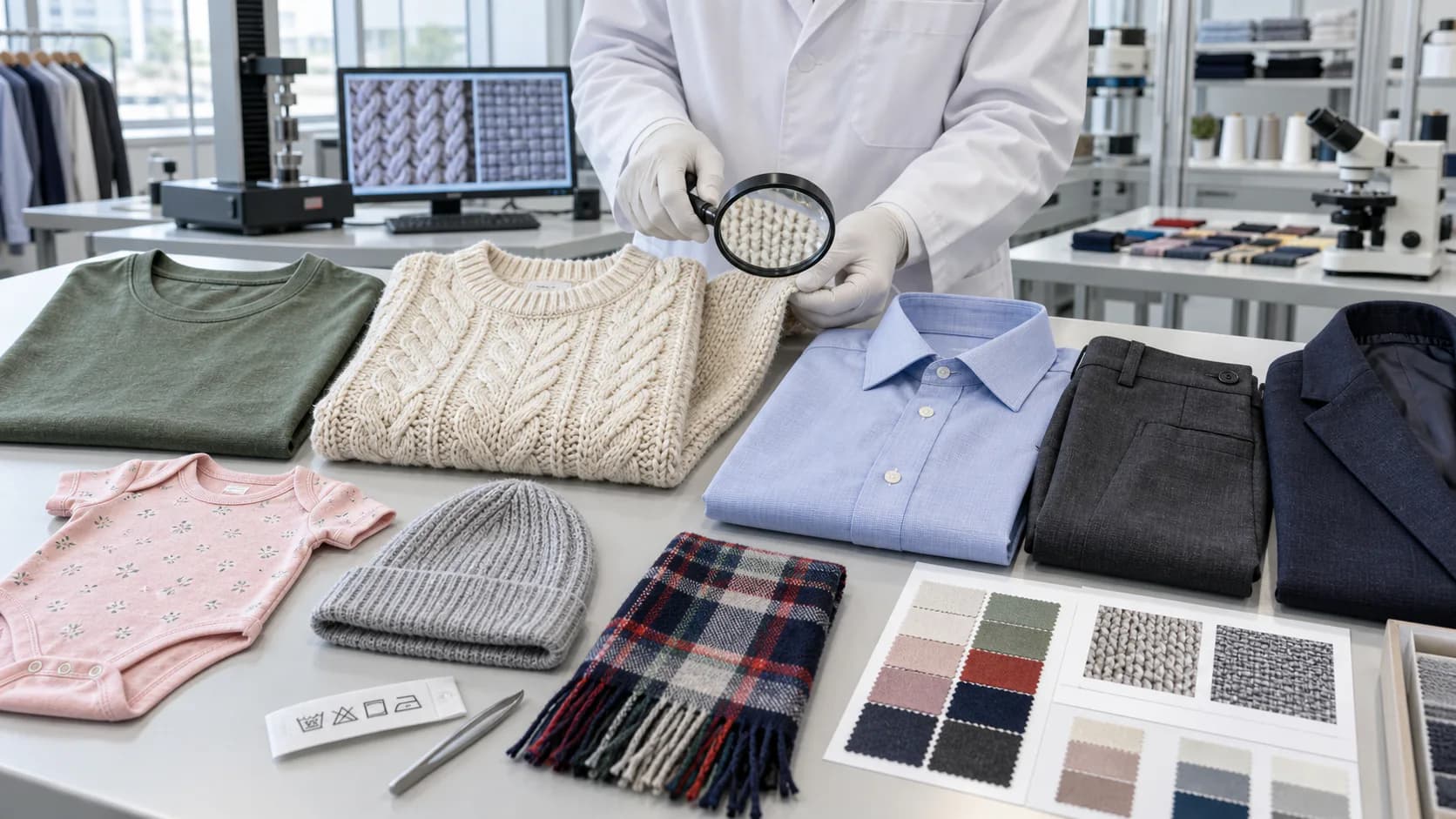
Quick answer: CN code and import requirements
Conditional answer: knitted or crocheted garments and accessories belong in Chapter 61; garments and accessories not knitted or crocheted belong in Chapter 62. There is no single eight-digit CN code or duty for apparel. Garment identity, sex or infant status, chief-weight fibre, construction, coating and set configuration determine the code. Ordinary new fashion apparel does not carry a general EU import licence or CE mark, but the importer must separately verify TARIC measures, origin, VAT, REACH restrictions, Regulation (EU) 1007/2011 fibre labelling and Regulation (EU) 2023/988 general product-safety obligations.
| Article | Knit/crochet | Other construction |
|---|---|---|
| Coats | 6101-6102 | 6201-6202 |
| Suits, jackets, trousers, dresses | 6103-6104 | 6203-6204 |
| Shirts and blouses | 6105-6106 | 6205-6206 |
| Underwear and nightwear | 6107-6108 | 6207-6208 |
| Babies' garments | 6111 | 6209 |
| Coated and other garments | 6113-6114 | 6210-6211 |
| Accessories | 6115-6117 | 6212-6217 |
Deciding between Chapters 61 and 62
Apply GIR 1, Section XI and Chapter 61-62 notes, followed by GIR 6. Knitted loop structure is distinguished from woven warp-and-weft construction. T-shirts, sweaters, babies' garments, brassieres and coated-fabric garments have specific headings. Section XI Note 14 normally separates garments of different headings even when sold as a set. Unisex treatment, infants' criteria and textile mixtures follow the legal notes rather than marketing labels. Used clothing moves to heading 6309 only if its condition and bulk packing satisfy that heading.
Review the technical documents before selecting the eight-digit CN code
The file must show a sample, macro fabric image, garment pattern, wearer and sex, body-size range, shell and lining fibres by weight, coating, pockets and closures, parts of a set, treatment and performance claims. Section XI Note 2 governs mixed textiles; price or visual prominence is not the test. Reconcile tech pack, BOM, cutting and sewing record, composition test, label, invoice and each SKU. A different stitch, fibre balance or design may change the CN subdivision, so a collection should not be entered under one code without line-by-line analysis.
Customs duty, preference and import VAT
Third-country duty is read from the live TARIC using the complete CN/TARIC code, origin, value and declaration date. Preferential duty requires a qualifying product-specific origin rule and valid proof; the shipping country alone is insufficient. Import VAT is charged under the destination Member State's rules and customs valuation base. Ordinary apparel generally bears the standard national VAT rate, but territory, special scheme and importer status must be checked. Antidumping, sanctions or quotas are separate TARIC measures; a zero conventional duty does not prove zero landed taxes.
Preferential origin for apparel
Apparel origin rules often require specified spinning, knitting or weaving, cutting and making-up operations. Under the EU-Vietnam FTA, Chapter 61 rules distinguish assembled knitted pieces from other knitted-to-shape products, while Chapter 62 has its own product-specific operations. Rules differ under each agreement and may include tolerances and cumulation. Keep yarn and fabric supplier records, cutting tickets, production orders, factory identity, transport evidence and origin declarations. Relabelling, repacking or minor finishing in an intermediary country does not automatically confer origin.
REACH chemicals and product safety
REACH Annex XVII restricts substances in articles, including certain azo colourants and other chemicals relevant to textiles; scope and concentration limits must be checked against the current entry and intended skin contact. The GPSR, applicable since 13 December 2024, requires a safe product, technical risk assessment, traceability, responsible economic operator, complaint and recall processes, and prescribed information for distance sales. Tests should cover the actual colourways, prints, coatings, trims and production lots. A fabric certificate cannot cover later chemical finishing without a reasoned equivalence assessment.
Textile fibre and consumer labelling
Regulation (EU) 1007/2011 requires prescribed fibre names and composition percentages, durable, legible and accessible information, and disclosure of non-textile parts of animal origin where applicable. Consumer information must be in the official language required by the Member State of sale. Care, size and country-of-origin statements may also be governed by national consumer law and unfair-practice rules. Claims such as pure cotton, recycled, antimicrobial, UV protective or flame resistant need evidence. The label, online offer, customs documents and test report must identify the same product.
Children, PPE, coated and used garments
Children's clothing needs a specific risk assessment for cords, drawstrings, small components and chemical exposure. Protective garments that fall within Regulation (EU) 2016/425 require the applicable conformity assessment, EU declaration and CE marking; ordinary fashion garments do not. Coated goods require analysis of both base fabric and visible coating. Wildlife-derived trims may trigger CITES. Worn clothing and textile waste require separate customs, waste-shipment, hygiene and national market checks. Counterfeit marks and unsafe products may be detained even where the CN code and duty are correct.
Customs file and declaration wording
Retain the contract, invoice, packing list, transport document, valuation and origin proof, tech pack, BOM, fibre-weight calculation, fabric images, size/sex evidence, REACH declarations and tests, GPSR risk file, labels and responsible-person data. Suggested wording: ‘Men's woven cotton shirts, long sleeve, 100% cotton by weight, not knitted or crocheted, not coated, sizes ..., new, origin ...’. Replace all decisive facts for knitted tops, trousers, dresses, infants' wear or accessories. ‘Garments’ is not an auditable customs description for a mixed shipment.
Official European Union sources
Official sources checked 12 September 2026: EU Access2Markets and TARIC assistant, Regulation (EU) 1007/2011 on textile fibre labelling, Regulation (EU) 2023/988 on general product safety, ECHA REACH Annex XVII restrictions and EU-Vietnam FTA product-specific origin rules. Recheck TARIC measures, VAT and national language rules on the declaration and sale dates.
Limits and pre-import actions
This guide is not a Binding Tariff Information decision or conformity approval for an unidentified SKU. Final advice requires the sample, construction, garment identity, sex or age, fibre weights, lining, coating, set configuration, claims, producer, origin chain, value and import date. Build a SKU matrix before ordering, test representative pre-production samples and contractually allocate classification, origin, restricted-substance, label, recall and re-export liability. For recurring material imports, consider BTI. Search optimisation cannot guarantee indexing, ranking or AI citation; authority depends on accurate evidence and timely maintenance.