Quick answer
Classify a complete tuner-free LCD computer monitor, distinguish display modules and other monitors, and review duty, Chapter 99, FCC, marking, UFLPA and entry records.
U.S. classification and admissibility conclusion
Conditional conclusion: a complete color LCD desktop monitor with its housing, control electronics, stand, power input and HDMI, DisplayPort or USB-C interfaces, capable of directly connecting to and designed for use with an automatic data processing machine of heading 8471, without a television tuner, is classifiable in HTSUS 8528.52.00.00. The 2026 HTSUS Column 1 General rate is Free and Column 2 is 35%. A bare display module, television, automotive display, medical monitor, digital-signage apparatus or multifunctional smart display needs separate analysis. Ordinary new computer monitors are not categorically prohibited, but tariff treatment does not replace FCC, origin and supply-chain compliance.
Why HTSUS 8528.52.0000 applies
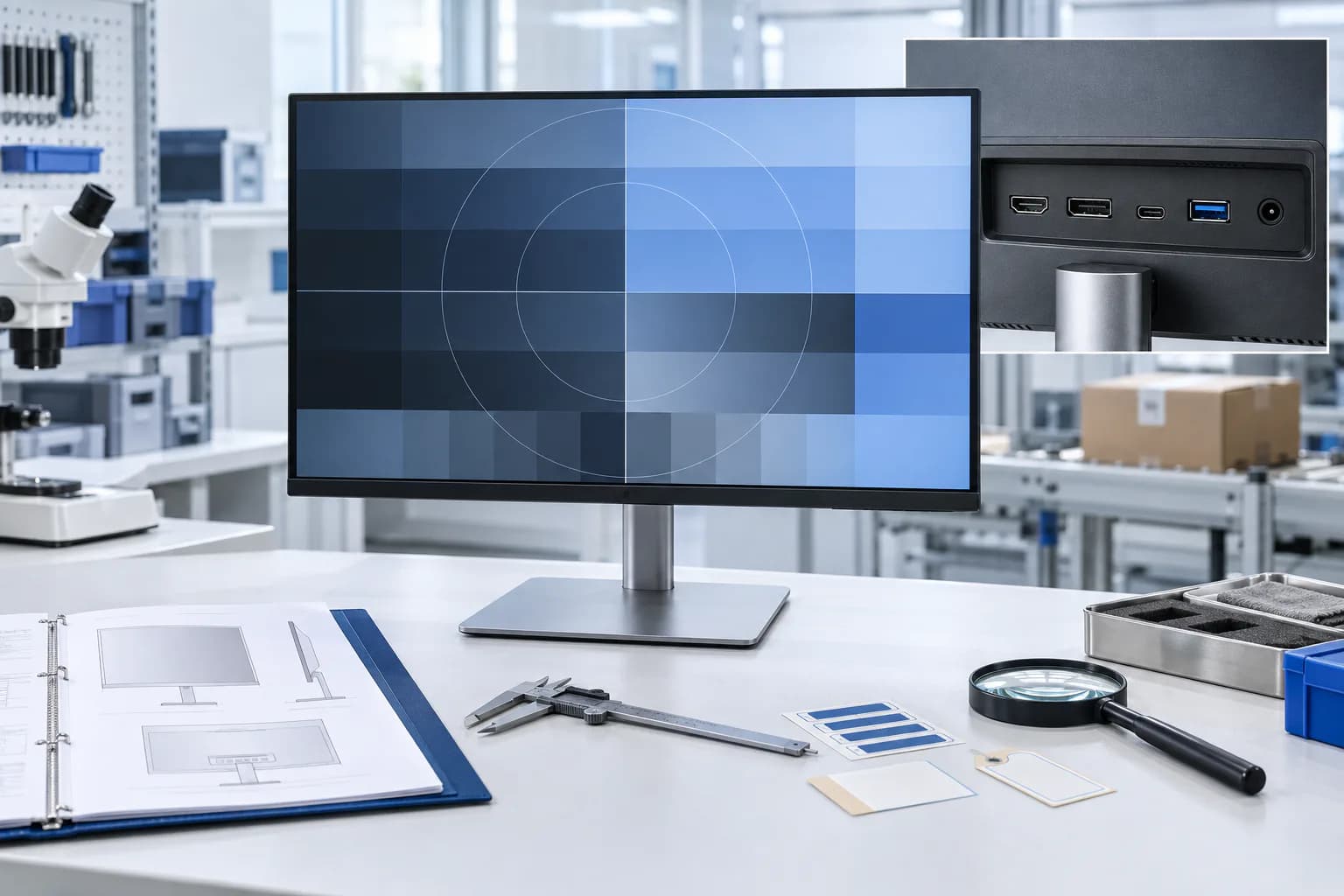
Apply GRI 1 and 6 to the imported condition. Evidence should establish LCD technology, diagonal, pixel pitch, native resolution, refresh rate, near-viewing design, input formats, ADP connectors, OSD controls and absence of a channel selector or video tuner. Integrated speakers, webcam, USB hub, KVM or USB-C power delivery normally do not displace the monitor function. A self-contained operating system, storage, cellular modem or dominant videoconferencing function may change the analysis. CBP evaluates objective features, not the words “LCD,” “gaming” or “smart monitor” on an invoice.
Display modules and other competing headings
Heading 8524, including LCD subheading 8524.11, covers flat-panel display modules that have not acquired the character of a complete monitor. Backlight and pixel-addressing electronics may still be consistent with a module; a housing, signal-processing board, user controls and external video inputs point toward heading 8528. Subheading 8528.59 covers other monitors not satisfying the ADP connection/design test. Televisions with reception apparatus belong in 8528.71 through 8528.73. CBP HQ ruling H325872 illustrates that an LCD assembly with signal decoding and a completed display function can be a monitor rather than a module.
Base duty and Chapter 99
For 8528.52.00.00, the base duty is Free. The USTR legacy China Section 301 search identifies this tariff line at 0.0%, and the July 2026 forced-labor Section 301 action lists 8528.52.00 in U.S. note 52(b)'s product exclusions; enter the applicable exclusion provision 9903.05.86 when required by the current HTS instructions. That exclusion is tariff-specific and does not waive UFLPA. MPF applies to formal entries and HMF may apply to ocean cargo. Recheck the live HTS revision, origin, entry date, any AD/CVD scope and all Chapter 99 notes before filing.
FCC equipment authorization
An LCD monitor is a digital device and unintentional radiator under 47 CFR Part 15. It generally must follow FCC Supplier's Declaration of Conformity or certification rules, with responsible-party, labeling, user-information and record obligations. A model incorporating Wi-Fi, Bluetooth or another intentional radiator requires FCC certification for the transmitter and compliant host integration, antennas, RF exposure and simultaneous-transmission conditions. Obtain the grant, test report, FCC ID, U.S. responsible-party file and user manual for the exact hardware/firmware version before shipment.
Origin marking, UFLPA and product safety
Mark the actual country of origin under 19 U.S.C. 1304 and 19 CFR Part 134; final assembly does not automatically establish substantial transformation where the LCD panel, main board and power supply come from different countries. UFLPA and 19 U.S.C. 1307 apply independently of the tariff exclusion, so retain traceability for panel glass, electronics, aluminum and other high-risk inputs. General consumer monitors also need a substantiated safety file and state-law review; medical, vehicle, aviation or workplace-specialized units may invoke additional agency rules. ENERGY STAR is voluntary and must not be represented without a valid certification.
Entry file and recommended description
Keep the commercial invoice, packing list, bill of lading, bond, valuation file, BOM, manufacturing flow, origin memorandum, datasheet, photographs, port diagram, tuner declaration, FCC records, safety reports, labels, manuals and trademark authorization. Recommended description: “Color LCD desktop computer monitor, ...-inch diagonal, ... resolution, HDMI/DisplayPort/USB-C inputs, without television tuner, model ..., country of origin ..., HTSUS candidate 8528.52.0000.” Separate models when panel, radio, power supply or principal use differs.
Classification and enforcement risk
Material risks include importing a module as a finished monitor, using 8528.52 for signage or a special-purpose display, assuming HDMI proves ADP design, and applying an exclusion without the required Chapter 99 line. CBP can test ports, firmware and actual capability and compare marketing materials. Seek a binding ruling where the smart functionality, specialized use or assembly condition creates a genuine heading boundary. Contracts should allocate reclassification, additional duty, FCC failure, detention, re-export and recall costs.
Official U.S. sources
Official sources checked 12 September 2026: 2026 HTSUS, CBP ruling H325872, FCC equipment authorization, USTR Section 301 search and the July 2026 Federal Register action. Check current CROSS rulings, Chapter 99 and agency status immediately before entry.
Limits and pre-shipment actions
This is conditional general guidance, not a CBP ruling or FCC authorization. A final opinion requires front/rear photos, model, LCD technology, size, resolution, port and signal list, tuner status, processor/storage/OS, radio bands, camera, speakers, power architecture, intended market, manufacturing stages, component origins, value and entry date. Before loading, reconcile the imported model with the FCC and safety file, verify the exclusion line, test origin marking and retain a representative sample.
Official sources to verify
- WCO — HS Nomenclature 2022 and General Rules for Interpretation
- United States International Trade Commission — Harmonized Tariff Schedule
Editorial note
Prepared by the Global HS Code Checker Editorial Team for customs-classification, tariff and import-policy research. The correct code and applicable measures may change with the merchandise's actual characteristics, jurisdiction, entry date and supporting record. Verify the current tariff, governing measures and competent customs authority before filing an entry. A reviewer is identified only after a named expert has completed the review.