Quick answer
Classify household table and box fans rated at no more than 125 W and review duty, Chapter 99, CPSC, electrical safety, FCC and origin-marking requirements.
Classification and duty conclusion
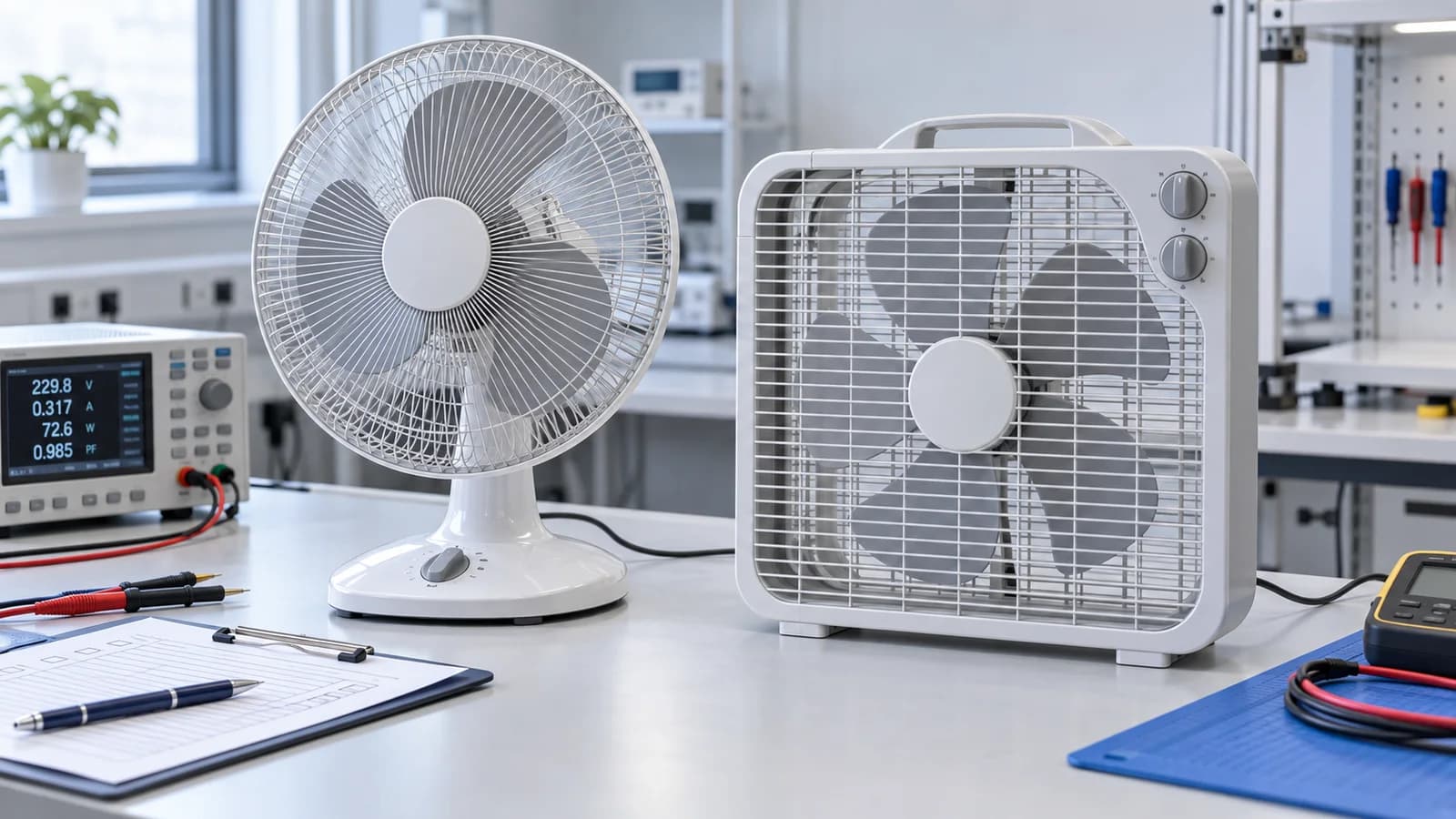
A finished household table fan or portable box fan with a self-contained electric motor whose output does not exceed 125 W is ordinarily entered under HTSUS 8414.51.9090, other fans not for permanent installation. The 2026 Column 1 General rate is 4.7% and Column 2 is 35%. CBP ruling N340219 classifies a portable table-suitable misting fan in the same provision and emphasizes actual size, intended placement and motor output. The conclusion does not cover ceiling or permanently installed fans, industrial blowers, HVAC components, computer fans, air coolers, heaters or separately entered parts.
Why 8414.51.9090 applies
GRI 1 places the complete appliance in heading 8414; GRI 6 leads to subheading 8414.51 because the fan is of the named table/box type and the self-contained motor output is no more than 125 W. The U.S. statistical split then distinguishes permanent installation from other products. Keep evidence of motor output, not only electrical input, together with dimensions, blade and guard design, base or carry handle, operating orientation, speed control, oscillation, power source and any misting, heating, filtration or radio feature. A product marketed as portable but engineered for fixed mounting requires a different statistical breakout.
China and Vietnam additional duties
The 4.7% base rate is only the first layer. The current USTR technology-transfer database records the 8414.51.90 line in List 4 with a 0% additional rate, but Chapter 99 must still be reviewed on the entry date. Under the separate 2026 forced-labor Section 301 action, qualifying China-origin goods may require 9903.05.31 at 12.5%, and Vietnam-origin goods may require 9903.05.84 at 12.5%, unless the operative U.S. note provides an exception. Origin follows substantial transformation, not shipment or invoicing. MPF and, for ocean entries, HMF remain separate; UFLPA supply-chain screening is not a tariff and must not be omitted.
Consumer-product and electrical compliance
There is no single federal import licence merely because an article is a household fan. The importer must nevertheless evaluate the Consumer Product Safety Act, defect reporting under section 15(b), and certificate/eFiling rules when a mandatory CPSC rule applies. Electrical listing to UL 507, Electric Fans, is commonly required by retailers, insurers and local electrical authorities, although a voluntary standard is not automatically a federal pre-entry certificate. The compliance file should address access to blades, guard openings, stability, tip-over, locked-rotor heating, motor protection, cord anchorage, grounding or double insulation, abnormal operation, fire and foreseeable child contact.
FCC, batteries and marking
Electronic speed controls can be unintentional radiators under FCC Part 15; Wi-Fi, Bluetooth or another transmitter requires the applicable equipment authorization and labeling. Rechargeable models require battery transport testing and a separate classification review if the product no longer fits the stated mains-powered configuration. Country-of-origin marking must comply with 19 U.S.C. 1304 and 19 CFR part 134. Labels and instructions should state model, voltage, frequency, input, motor output where material, manufacturer/importer, intended table or box use, indoor/outdoor limitation, cleaning and guard warnings. California Proposition 65 or other state rules are separate fact-specific reviews.
Entry file and description
Keep the invoice, packing list, transport and origin record; bill of materials and manufacturing flow; specification, photos and manual; motor input/output data; blade, guard, stability and thermal-protection reports; electrical listing record; FCC and battery evidence; labels and traceability. Suggested description: “Household portable table fan/box fan, self-contained electric motor output ... W not exceeding 125 W, ... V, ... Hz, guarded blades, ... speeds, not for permanent installation, model ..., new, country of origin ..., HTSUS 8414.51.9090.” Replace every blank and disclose additional functions.
Facts that change the answer
Reclassify or seek a CBP ruling when the fan is designed for permanent ceiling, wall, window or roof installation; exceeds 125 W output; is a cordless miniature product; forms part of HVAC, refrigeration or computer equipment; includes material evaporative cooling, misting, heating, air purification or lighting functions; is imported as an unassembled set; or consists only of a motor, blade, guard, housing or controller. Tariff classification, Chapter 99, origin, UFLPA, CPSC, FCC, battery transport and state requirements are separate determinations.
Official sources
Sources reviewed September 21, 2026: USITC HTS search for 8414.51; CBP ruling N340219; USTR Section 301 tariff search; CPSC certificate and eFiling guidance; FCC equipment authorization; CBP country-of-origin marking.
Editorial note
Prepared by the Global HS Code Checker Editorial Team for customs-classification, tariff and import-policy research. The correct code and applicable measures may change with the merchandise's actual characteristics, jurisdiction, entry date and supporting record. Verify the current tariff, governing measures and competent customs authority before filing an entry. A reviewer is identified only after a named expert has completed the review.